
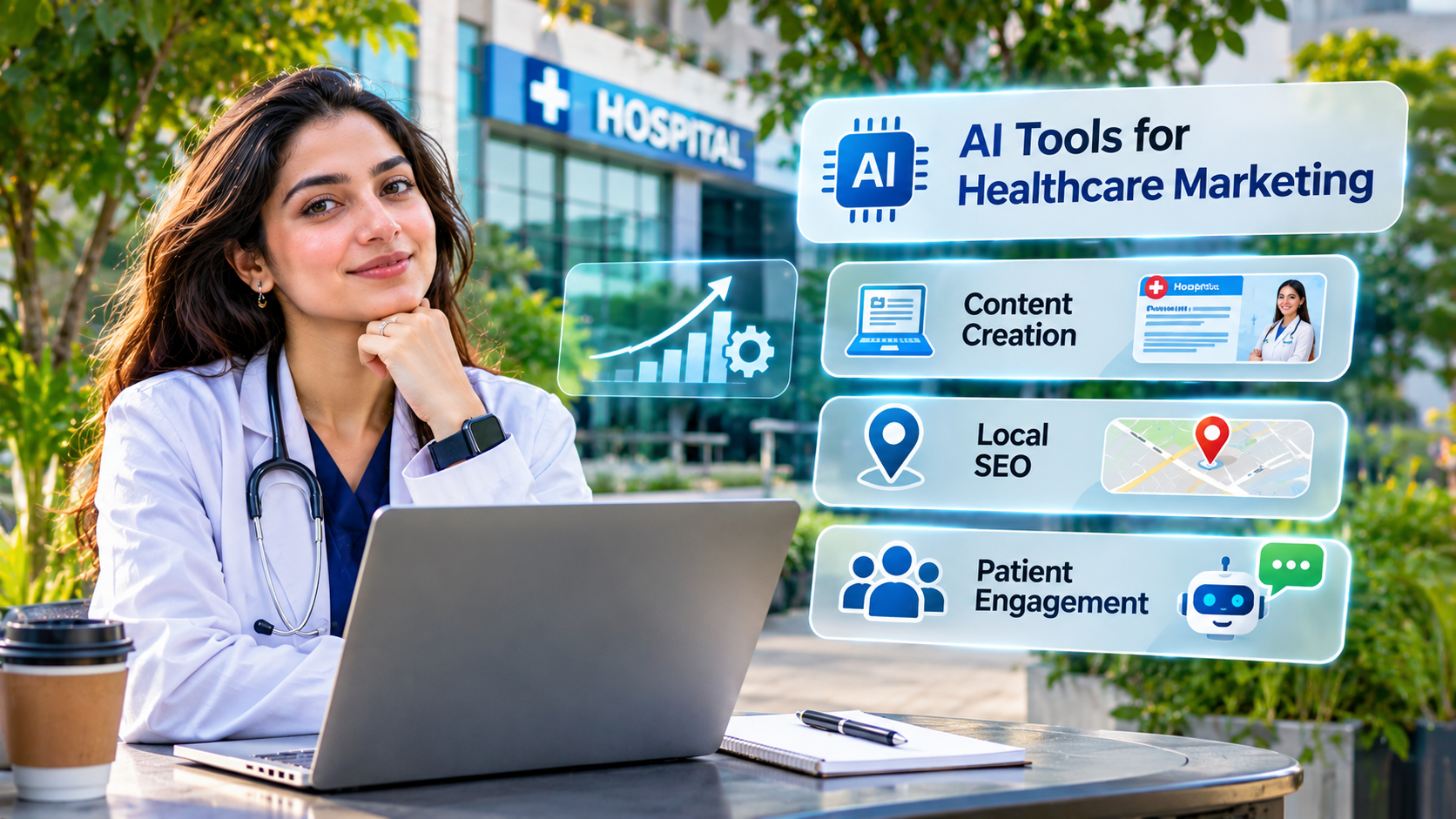
The healthcare industry is becoming increasingly digital. Patients now use online search engines, websites and digital platforms to find hospitals, clinics, doctors and healthcare services. Before booking an appointment, many people search for treatment information, compare nearby clinics and check healthcare service details.
Artificial Intelligence (AI) is making healthcare marketing more efficient by helping marketing teams create content, improve search engine optimization (SEO), manage local search visibility and communicate with website visitors.
With the right AI tools, healthcare businesses can simplify marketing activities, improve their online visibility and create better patient engagement experiences.
In this blog, we will explore how healthcare businesses can use AI tools for content creation, local SEO and patient engagement, along with practical strategies for implementing them.
1. How AI Is Transforming Healthcare Marketing
Traditional healthcare marketing often involves manually creating website content, managing social media accounts, updating service pages and responding to customer enquiries.
These activities require time, planning and consistent effort.
AI tools can support healthcare marketing teams by simplifying repetitive tasks and helping them organize their marketing activities.
Some important applications of AI in healthcare marketing include:
-
Creating healthcare blog outlines and content drafts.
-
Generating social media content ideas.
-
Improving website content readability.
-
Supporting keyword research.
-
Optimizing local SEO content.
-
Creating marketing visuals.
-
Managing general website enquiries.
-
Automating administrative follow-ups.
-
Analyzing website and campaign performance.
For example, a dental clinic can use AI to prepare an initial blog outline about dental consultations, create social media content and identify relevant local search topics.
The clinic's marketing team can then review the content to ensure that all medical information is accurate before publishing.
AI should support healthcare professionals and marketing teams, not replace medical expertise or human judgment.
2. AI Tools for Healthcare Content Creation
Content creation is an important part of healthcare digital marketing. Hospitals and clinics need informative website pages, educational blogs, social media posts and service descriptions to communicate with potential patients.
AI tools can help healthcare marketing teams develop content more efficiently.
AI for Healthcare Blog Writing
AI writing tools can assist with researching content ideas, preparing blog structures and creating initial drafts.
For example, a physiotherapy clinic may want to publish an article about preparing for a physiotherapy consultation.
An AI writing tool can help generate:
-
Blog topic ideas.
-
SEO-friendly headings.
-
Article outlines.
-
Frequently asked questions.
-
Meta description drafts.
-
Social media captions.
The healthcare team should review the information, remove unsupported claims and ensure that medical explanations are accurate.
AI for Social Media Content Creation
Social media platforms allow healthcare businesses to share educational information, clinic updates and service-related content.
AI can help create a consistent social media content calendar.
Healthcare businesses can use AI to prepare:
-
Health awareness post ideas.
-
Clinic introduction captions.
-
Doctor profile content.
-
Service announcements.
-
Educational carousel outlines.
-
Short video scripts.
-
Appointment reminder drafts.
For example, a diagnostic centre can use AI to prepare a monthly content calendar covering available services, general health awareness and information about booking appointments.
All health-related content should be checked by qualified professionals before publication.
AI for Healthcare Images and Videos
Visual content can make healthcare information easier to understand.
AI-powered design and video tools can assist with creating:
-
Healthcare educational graphics.
-
Social media creatives.
-
Service promotional banners.
-
Short informational videos.
-
Website illustrations.
-
Presentation visuals.
For example, a hospital marketing team can create an educational graphic explaining the general steps involved in booking a consultation.
Visuals should be professional, clear and medically appropriate. Avoid misleading medical images or visuals that suggest guaranteed treatment outcomes.
3. AI Tools for Healthcare SEO
Search Engine Optimization helps healthcare businesses improve their visibility in search engine results.
When people search for nearby clinics, doctors or medical services, an optimized website has an opportunity to appear in relevant search results.
AI-powered SEO tools can assist with keyword research, content optimization and website analysis.
AI-Powered Healthcare Keyword Research
Keyword research helps healthcare businesses understand what potential patients search for online.
AI tools can help identify relevant search topics based on healthcare services and locations.
Examples include:
-
Dental clinic in Delhi.
-
Skin specialist in Rajouri Garden.
-
Physiotherapy centre in Noida.
-
Diagnostic centre near me.
-
General physician in Gurgaon.
Healthcare businesses can use these topics to plan website pages, blog articles and local search content.
Select keywords based on the actual services offered by the healthcare business.
AI for On-Page SEO Optimization
On-page SEO involves optimizing individual website pages to make their content easier for search engines and visitors to understand.
AI can assist with:
-
SEO title suggestions.
-
Meta description drafts.
-
Heading improvements.
-
Content readability.
-
Keyword placement.
-
Content structure.
-
Frequently asked questions.
For example, a clinic may have a service page titled "Our Services."
AI can help suggest a more descriptive heading based on the actual service, such as "Dental Consultation Services in Delhi."
The final heading should accurately represent the services provided.
AI for Healthcare Blog Optimization
Healthcare blogs can attract visitors who are searching for general medical information and healthcare services.
AI can help identify content gaps and suggest improvements to existing articles.
For example, a clinic publishing an article about dental consultations can use AI to identify additional questions that readers may find useful.
However, AI-generated medical information should always be reviewed by qualified healthcare professionals.
4. Use AI for Local SEO and Nearby Patient Discovery
Local SEO is particularly important for healthcare businesses because patients often search for services within their nearby areas.
A clinic with a strong local online presence can make it easier for potential patients to discover its location and available services.
Optimize Google Business Profile Information
A Google Business Profile helps healthcare businesses display important information in local search results.
AI can assist with preparing business descriptions, service summaries and responses to general customer reviews.
Healthcare businesses should maintain:
-
Correct clinic or hospital name.
-
Accurate address.
-
Updated contact information.
-
Working hours.
-
Relevant business categories.
-
Available services.
-
Genuine photographs.
-
Accurate appointment information.
Always verify AI-generated information before adding it to your business profile.
Create Location-Based Healthcare Pages
Healthcare businesses operating in multiple areas can create separate location pages for their branches.
For example, a clinic with branches in Delhi and Noida can create individual pages describing the services available at each location.
Each page can include:
-
Branch address.
-
Available healthcare services.
-
Consultation information.
-
Contact details.
-
Appointment options.
-
Directions and accessibility information.
AI can help organize the content structure and prepare initial location-specific drafts.
However, each page should contain accurate and genuinely useful information rather than duplicated content with only the location name changed.
Manage Patient Reviews Professionally
Online reviews can influence how potential patients evaluate healthcare providers.
AI can assist with preparing professional responses to general feedback.
For example, if a patient leaves a positive review about the clinic's reception service, AI can help draft a polite thank-you response.
Never include private patient information or discuss someone's medical history in a public review response.
5. AI Tools for Better Patient Engagement
Patient engagement involves making communication between healthcare businesses and patients more accessible, organized and helpful.
AI-powered communication tools can support healthcare businesses in managing general enquiries and providing basic service information.
AI Chatbots for Website Enquiries
AI chatbots can interact with visitors and answer approved general questions about healthcare services.
For example, when someone visits a clinic website, a chatbot can ask:
-
Which healthcare service are you interested in?
-
Which clinic location would you prefer?
-
Would you like appointment information?
-
Do you need assistance contacting the clinic?
Based on the answers, the chatbot can guide visitors towards the relevant service page or appointment enquiry form.
Chatbots should not diagnose medical conditions, recommend treatments or replace communication with qualified healthcare professionals.
Automated Appointment Enquiries
AI automation can help healthcare businesses manage appointment-related administrative activities.
For example, when someone submits an appointment request through a website, an automated workflow can:
-
Receive the enquiry.
-
Send an acknowledgement.
-
Notify the relevant clinic team.
-
Record the request in an approved system.
-
Help staff organize the follow-up process.
The system should clearly distinguish between an appointment request and a confirmed appointment.
Automated Follow-Up Communication
Healthcare businesses can use automation to send appropriate administrative reminders and updates.
Examples include:
-
Appointment confirmation messages.
-
Appointment reminders.
-
General clinic information.
-
Enquiry acknowledgement messages.
-
Administrative follow-up notifications.
Communication should follow patient consent and applicable privacy requirements.
Avoid using sensitive patient information in general-purpose AI tools without appropriate authorization and safeguards.
6. AI for Healthcare Marketing Analytics
Healthcare marketing teams need to understand how their websites and digital campaigns are performing.
AI-powered analytics tools can help organize marketing information and identify patterns that require attention.
Analyze Website Performance
AI can assist with reviewing website performance information such as:
-
Website traffic.
-
Popular service pages.
-
Organic search visits.
-
Enquiry form submissions.
-
Landing page performance.
-
Visitor engagement.
For example, if a clinic receives visitors through its dental services page but receives very few enquiries, the marketing team can review the page structure, contact options and appointment form.
Monitor Local SEO Performance
Healthcare businesses can review local search visibility and understand which location pages attract relevant visitors.
AI-assisted analysis can help identify:
-
Location pages requiring improvement.
-
Search topics attracting visitors.
-
Frequently visited service pages.
-
Content gaps.
-
Opportunities to improve website information.
Improve Marketing Decisions
Instead of relying on assumptions, healthcare marketing teams should use actual performance data to improve their content and marketing strategies.
For example, if a particular service page generates more relevant enquiries than other pages, the business can investigate which content and website elements are contributing to its performance.
Always protect patient confidentiality when analyzing healthcare marketing data.
7. Best Practices for Using AI Tools in Healthcare Marketing
Although AI provides several marketing opportunities, healthcare businesses must use these tools responsibly.
Follow these important practices:
Review All Medical Information
AI-generated content can contain incorrect or incomplete medical information.
Qualified healthcare professionals should review medical content before publication.
Protect Patient Privacy
Do not upload confidential patient records, medical reports or identifiable health information into AI tools without appropriate authorization and security safeguards.
Maintain Human Communication
AI chatbots can answer approved general questions, but patients should have an option to communicate with human staff.
Avoid Misleading Marketing Claims
Do not use AI to create false treatment claims, guaranteed results or unsupported healthcare advertisements.
Keep Website Information Updated
Regularly review clinic addresses, service descriptions, consultation details and appointment information.
Accurate information helps patients understand the services available and how to contact the healthcare provider.
8. How to Build an AI-Powered Healthcare Marketing Strategy
Healthcare businesses can introduce AI into their marketing activities through a simple step-by-step process.
Step 1: Understand Your Marketing Goals
Identify whether your priority is improving website visibility, creating educational content, increasing local discovery or managing patient enquiries.
Step 2: Choose Relevant AI Tools
Select tools based on your requirements, such as content creation, SEO research, visual design, chatbots or marketing automation.
Step 3: Optimize Your Healthcare Website
Improve service pages, add relevant keywords, provide accurate business information and make appointment options easy to find.
Step 4: Develop a Content Calendar
Plan healthcare blogs, educational social media posts and service-related content.
Use AI for initial ideas and drafts, followed by professional review.
Step 5: Improve Patient Engagement
Introduce approved chatbot workflows and enquiry acknowledgement systems to support communication.
Step 6: Track and Improve Results
Monitor website traffic, local search performance, enquiry submissions and communication efficiency.
Make improvements based on actual results.
Conclusion
AI tools are becoming valuable resources for healthcare businesses that want to improve their digital marketing activities.
From healthcare content creation and SEO optimization to local search visibility and patient engagement, AI can help marketing teams organize their work and manage repetitive tasks more efficiently.
Content creation tools can support educational blogs and social media campaigns. AI-powered SEO tools can assist with keyword research and website optimization, while chatbots and automation workflows can improve general enquiry management.
However, healthcare businesses must prioritize medical accuracy, patient privacy and responsible communication when using AI.
At Upskill Now, learners can explore practical digital marketing and artificial intelligence skills that are relevant to modern business marketing. The AI Digital Marketing Master Program covers areas such as SEO, AI tools, content marketing, Google Ads and marketing automation.
If you want to understand how AI tools can support content creation, SEO and marketing workflows, explore the AI and digital marketing learning programs available at Upskill Now.
Develop your practical knowledge, understand modern marketing tools and learn how to apply digital marketing strategies across different industries, including healthcare.
SEO Keywords
-
AI Tools for Healthcare Marketing
-
Healthcare Content Creation
-
Healthcare Local SEO
-
AI for Patient Engagement
-
Healthcare Digital Marketing
Frequently Asked Questions (FAQs)
1. What are the best AI tools for healthcare marketing?
Useful AI tool categories for healthcare marketing include AI writing assistants, SEO research tools, graphic design tools, video creation tools, chatbots and marketing automation platforms. The right tools depend on the healthcare business's content, SEO and patient communication requirements.
2. How can AI help with healthcare content creation?
AI can help healthcare marketing teams generate blog ideas, prepare article outlines, create social media captions, draft service descriptions and develop educational content. Qualified healthcare professionals should review medical information before publication.
3. How can AI improve local SEO for healthcare businesses?
AI can assist with local keyword research, location-specific content planning, business descriptions, website optimization and review response drafts. Healthcare businesses should also maintain accurate addresses, contact details, service information and working hours.
4. Can AI chatbots improve patient engagement?
Yes. AI chatbots can answer approved general questions, share clinic information and guide visitors towards appointment enquiry forms. They can support communication but should not diagnose medical conditions or replace healthcare professionals.
5. Is AI automation useful for healthcare marketing?
Yes. AI automation can support enquiry acknowledgements, appointment reminders, administrative notifications and marketing workflows. Healthcare businesses must use appropriate privacy safeguards and ensure that patient information is handled responsibly.
Contact Upskill Now
-
Address: A-3, Third Floor, Rajouri Garden, New Delhi – 110027, India
-
Contact Number: +91 99998 48160
-
Alternate Number: +91 97114 48765