
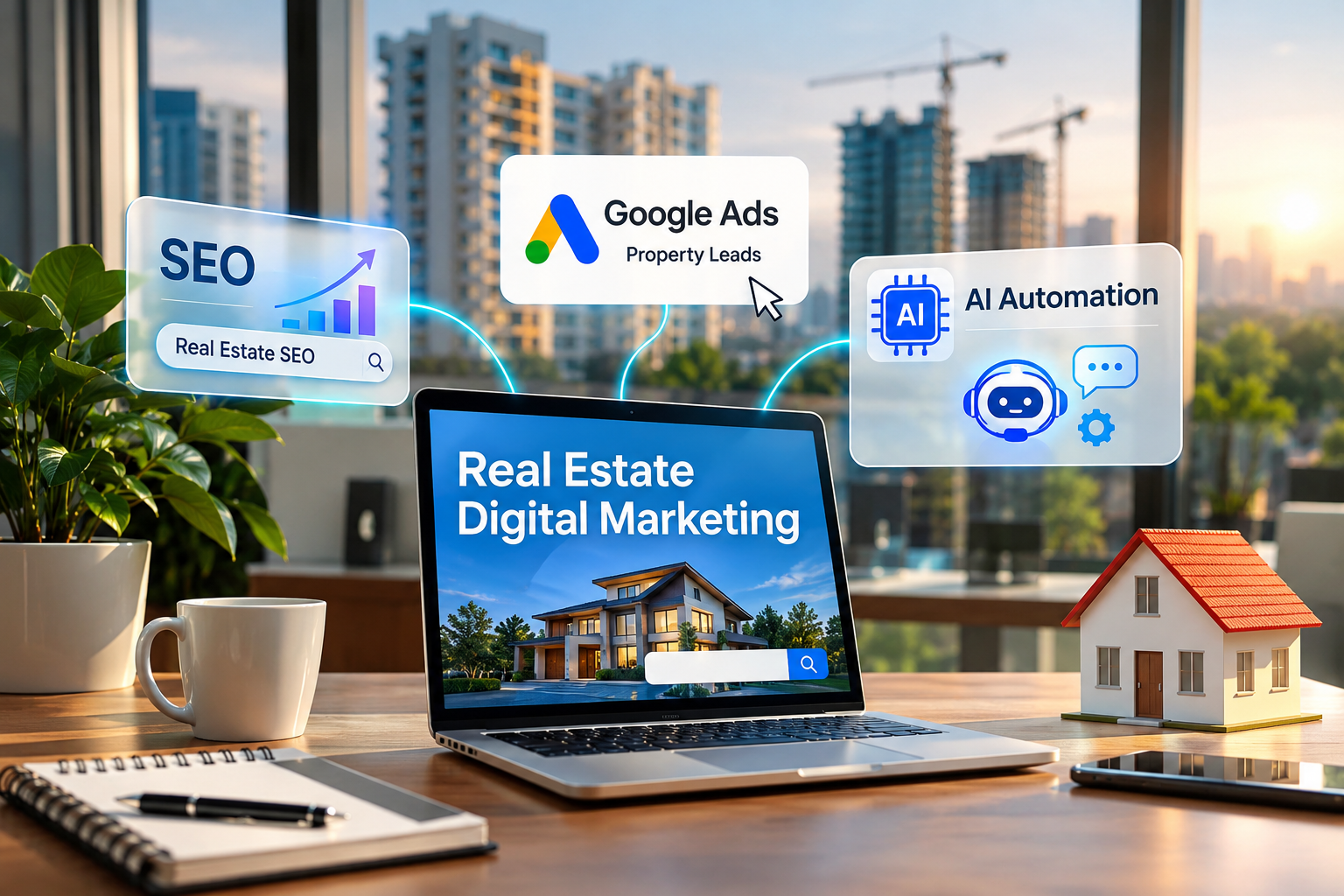
The real estate industry has become increasingly competitive, and property buyers now rely heavily on online platforms to search for properties, compare locations, explore prices and connect with real estate agents. Traditional marketing methods such as newspaper advertisements, banners and property exhibitions are still used, but digital marketing has become an important part of reaching potential customers.
Real estate businesses need a strong online presence to attract property buyers, generate quality leads and increase property enquiries. By combining Search Engine Optimization (SEO), Google Ads and AI automation, real estate companies can improve their visibility, reach targeted audiences and manage customer enquiries more efficiently.
In this blog, we will explore the best digital marketing strategies for real estate businesses and understand how SEO, Google Ads and AI automation can improve property marketing and lead generation.
1. Search Engine Optimization (SEO) for Real Estate Businesses
Search Engine Optimization (SEO) is one of the most effective long-term strategies for real estate businesses. It helps property websites appear in search engine results when potential customers search for properties, locations or real estate services.
For example, someone searching for "2 BHK flats in Rajouri Garden" may be interested in purchasing a property in that particular location. If your website contains relevant and well-optimized content, it has an opportunity to attract that potential customer.
Local SEO for Property Businesses
Local SEO helps real estate businesses reach customers searching for properties in specific cities, areas and neighbourhoods.
Real estate companies should focus on:
-
Adding accurate business information to their online profiles.
-
Creating location-specific website pages.
-
Optimizing property listings with relevant location keywords.
-
Adding accurate business contact information.
-
Collecting genuine customer reviews.
-
Creating useful content about local property markets.
For example, a real estate company operating in Delhi can create separate website pages for properties in Rajouri Garden, Dwarka, Rohini and other relevant locations.
This makes it easier for search engines and potential customers to understand the locations where the business operates.
Keyword Research for Real Estate Websites
Keyword research helps businesses understand what potential property buyers are searching for online.
Real estate businesses should target keywords based on property type, location and customer requirements.
Examples include:
-
Flats for sale in Delhi.
-
Affordable apartments in Noida.
-
Commercial property in Gurgaon.
-
Luxury residential properties in Delhi.
-
Rental flats near metro stations.
Use these keywords naturally in website titles, headings, property descriptions, blog posts and meta descriptions.
Avoid repeating the same keyword unnecessarily. Focus on creating useful content that answers customers' questions.
Optimize Property Listings
Property listing pages should provide complete and accurate information about available properties.
Include:
-
Property name and location.
-
Property type and size.
-
Number of bedrooms and bathrooms.
-
Available facilities and amenities.
-
Property price.
-
High-quality property photographs.
-
Clear enquiry and contact options.
For example, instead of writing only "Beautiful Apartment Available", use a descriptive heading such as "3 BHK Apartment for Sale in Dwarka, Delhi".
A clear heading provides better information to both search engines and potential buyers.
Create Helpful Real Estate Blogs
Blogging is another useful SEO strategy for real estate companies.
Publish informative articles that answer common property-related questions.
Some relevant blog topics include:
-
How to Choose the Right Residential Property.
-
Important Things to Check Before Buying a Flat.
-
Residential vs Commercial Property: Key Differences.
-
Best Locations to Buy Property in Delhi.
-
Tips for First-Time Home Buyers.
Useful blog content can attract organic visitors and help establish your business as a reliable source of property information.
2. Google Ads for Real Estate Lead Generation
Google Ads is a paid advertising platform that allows real estate businesses to display advertisements to people searching for relevant property-related services.
Unlike SEO, which generally takes time to build organic visibility, paid search campaigns can help businesses reach targeted audiences through advertisements.
However, successful campaigns require proper keyword selection, audience targeting, budget management and landing page optimization.
Search Ads for Property Enquiries
Search Ads are useful for reaching people who are actively searching for properties.
For example, a real estate company can create advertisements targeting searches such as:
-
Flats for sale in South Delhi.
-
Buy residential property in Noida.
-
Commercial office space in Gurgaon.
-
Luxury apartments for sale in Delhi.
The advertisement should clearly communicate the property offering and include a relevant call to action.
Examples of effective CTAs include:
-
Explore Available Properties.
-
Book a Property Visit.
-
Request Property Details.
-
Contact Our Sales Team.
Location-Based Advertising
Location targeting allows real estate businesses to focus their advertisements on selected geographical areas.
For example, a company selling residential apartments in Dwarka may prioritize audiences interested in that location rather than advertising across unrelated regions.
Businesses can organize campaigns according to:
-
Property location.
-
Property category.
-
Target customer requirements.
-
Campaign objectives.
-
Available advertising budget.
This approach helps make advertising more relevant to potential customers.
Create Dedicated Landing Pages
A landing page is a dedicated webpage designed to encourage visitors to take a specific action.
Instead of sending every advertisement visitor to the homepage, create individual landing pages for different property campaigns.
A good real estate landing page should include:
-
An attractive property headline.
-
High-quality property images.
-
Important property details.
-
Pricing information, where available.
-
Location and nearby facilities.
-
An enquiry form.
-
A visible call or WhatsApp contact option.
For example, an advertisement promoting luxury apartments should direct visitors to a landing page containing information about those apartments rather than a general property listing page.
Track Google Ads Performance
Real estate businesses should regularly evaluate their advertising campaigns to understand which advertisements are generating useful enquiries.
Important performance indicators include:
-
Number of clicks.
-
Advertising cost.
-
Number of enquiries.
-
Cost per lead.
-
Landing page conversion rate.
-
Quality of generated leads.
Tracking these indicators helps businesses identify which campaigns need improvement and where their advertising budget should be allocated.
3. AI Automation for Real Estate Marketing
Artificial Intelligence (AI) is changing how real estate businesses manage marketing activities and customer communication.
AI automation can help businesses handle repetitive tasks, organize enquiries, create marketing content and respond to customers more efficiently.
Instead of manually managing every marketing activity, real estate companies can use AI-powered workflows to support their sales and marketing teams.
AI Chatbots for Customer Enquiries
AI chatbots can interact with website visitors and answer common property-related questions.
For example, when a visitor opens a real estate website, a chatbot can ask:
-
Are you looking to buy or rent a property?
-
Which location are you interested in?
-
What type of property do you need?
-
What is your preferred budget?
-
When would you like to visit the property?
Based on the responses, the chatbot can collect enquiry information and direct the customer to the appropriate sales representative.
This helps businesses organize incoming enquiries and improve the initial customer experience.
Automated Lead Follow-Ups
Following up with potential property buyers is an important part of real estate sales.
However, managing multiple enquiries manually can become difficult.
AI automation and CRM workflows can help businesses:
-
Send automated enquiry confirmations.
-
Schedule follow-up reminders.
-
Organize customer information.
-
Assign enquiries to sales representatives.
-
Send property details to interested customers.
-
Track customer communication history.
For example, when someone submits a property enquiry form, an automated workflow can send a confirmation message and notify the relevant sales representative.
The sales team can then contact the customer personally and discuss their requirements.
AI for Real Estate Content Creation
Real estate companies regularly need content for their websites, advertisements, social media platforms and email campaigns.
AI tools can assist with creating:
-
Property descriptions.
-
Real estate blog ideas.
-
Social media captions.
-
Advertisement headlines.
-
Email marketing drafts.
-
Property video scripts.
-
Promotional content.
For example, a real estate marketer can provide basic property information and use AI to generate an initial property description.
The marketing team should review the content to ensure that all property specifications, prices, amenities and claims are accurate before publishing.
AI-Powered Customer Segmentation
Not every property enquiry has the same requirements.
Some customers may be looking for affordable apartments, while others may be interested in luxury homes or commercial properties.
AI-assisted customer segmentation can help businesses organize enquiries according to:
-
Property preferences.
-
Budget requirements.
-
Preferred locations.
-
Buying or rental interests.
-
Customer engagement.
-
Enquiry status.
This makes it easier for sales teams to understand customer requirements and share more relevant property options.
4. Combine SEO, Google Ads and AI Automation
SEO, Google Ads and AI automation deliver better results when they are used together as part of one marketing strategy.
Each strategy supports a different stage of the customer journey.
How These Strategies Work Together
Step 1: Attract Customers Through SEO
Optimize your website and publish location-specific property content to attract people searching for real estate information.
Step 2: Generate Enquiries Through Google Ads
Run targeted advertising campaigns to reach people actively searching for relevant properties.
Step 3: Capture Customer Information
Use website enquiry forms and landing pages to collect customer details and property requirements.
Step 4: Manage Enquiries Through AI Automation
Use automated workflows to organize leads, send confirmations and schedule follow-ups.
Step 5: Convert Interested Customers
The sales team can contact qualified prospects, answer their questions, arrange property visits and guide them through the purchasing process.
This integrated approach creates a more organized marketing and lead management system.
5. Optimize Your Real Estate Website for Conversions
A real estate website is often the first point of contact between a property business and a potential customer.
Therefore, the website should provide a professional experience and make it easy for visitors to explore properties and submit enquiries.
Improve Website Loading Speed
A slow website can create a poor user experience.
Optimize images, reduce unnecessary website elements and improve technical performance to make property pages load efficiently.
Make Your Website Mobile-Friendly
Many potential customers browse property listings through smartphones.
Ensure that your website works properly on mobile devices, with readable text, clear navigation and easy-to-use enquiry forms.
Add Clear Calls to Action
Every important property page should guide visitors towards the next step.
Use relevant CTAs such as:
-
Enquire Now.
-
Schedule a Site Visit.
-
Request a Callback.
-
View Property Details.
Build Trust Through Accurate Information
Provide genuine property images, accurate specifications, transparent pricing information where available and reliable contact details.
Avoid misleading property descriptions or unrealistic promotional claims.
A transparent website helps customers make informed decisions and improves the overall enquiry experience.
6. Measure and Improve Your Real Estate Marketing Strategy
Digital marketing requires regular monitoring and improvement.
Real estate businesses should evaluate their marketing performance to understand which strategies are attracting relevant visitors and generating valuable enquiries.
Important areas to monitor include:
SEO Performance: Monitor organic website traffic, search visibility, keyword performance and enquiries generated through organic search.
Google Ads Performance: Review clicks, advertising expenditure, cost per lead and enquiry quality.
AI Automation Performance: Evaluate response times, follow-up completion, lead organization and workflow efficiency.
Website Performance: Review landing page conversions, mobile usability and enquiry form submissions.
Based on these observations, businesses can improve their content, advertising campaigns and customer communication processes.
Conclusion
Digital marketing has become an important part of growing a real estate business. Companies that want to attract property buyers and generate relevant enquiries need a combination of strong SEO, targeted Google Ads campaigns and effective AI automation.
SEO helps improve organic visibility, Google Ads connects businesses with people actively searching for properties, and AI automation supports customer communication and lead management.
When these strategies work together, real estate businesses can create a more structured marketing process, improve their online presence and manage potential customers more effectively.
However, successful implementation requires practical knowledge of digital marketing, advertising, SEO, analytics and AI tools.
At Upskill Now, learners can explore practical opportunities to develop digital marketing and AI-related skills. The AI Digital Marketing Master Program covers important areas such as SEO, Google Ads, performance marketing, AI tools and marketing automation.
If you want to develop the skills required to plan and manage modern digital marketing campaigns, explore the available courses at Upskill Now and start building your practical knowledge.
Frequently Asked Questions (FAQs)
1. What are the best digital marketing strategies for real estate businesses?
The best strategies include search engine optimization (SEO), Google Ads, local SEO, content marketing, website optimization and AI automation. These strategies help real estate businesses improve online visibility, attract potential property buyers and manage enquiries.
2. How does SEO help real estate businesses generate leads?
SEO helps real estate websites appear in relevant search results when people look for properties, locations and real estate services. Location-based keywords, optimized property listings and informative blogs can attract organic visitors who may become potential customers.
3. How can Google Ads help generate real estate leads?
Google Ads allows real estate businesses to display advertisements to people searching for specific property-related services. With relevant keywords, location targeting and dedicated landing pages, businesses can attract interested visitors and encourage them to submit property enquiries.
4. How can AI automation improve real estate marketing?
AI automation can help real estate businesses manage website enquiries, automate follow-up reminders, organize customer information, generate marketing content and support customer segmentation. These processes can reduce repetitive manual work and improve lead management.
5. Can SEO, Google Ads and AI automation work together for real estate marketing?
Yes. SEO attracts organic visitors, Google Ads generates targeted website traffic, and AI automation helps manage incoming enquiries and follow-ups. Combining these strategies creates a more organized digital marketing process for real estate businesses.
Contact Upskill Now
-
Address: A-3, Third Floor, Rajouri Garden, New Delhi – 110027, India
-
Contact Number: +91 99998 48160
-
Alternate Number: +91 97114 48765