
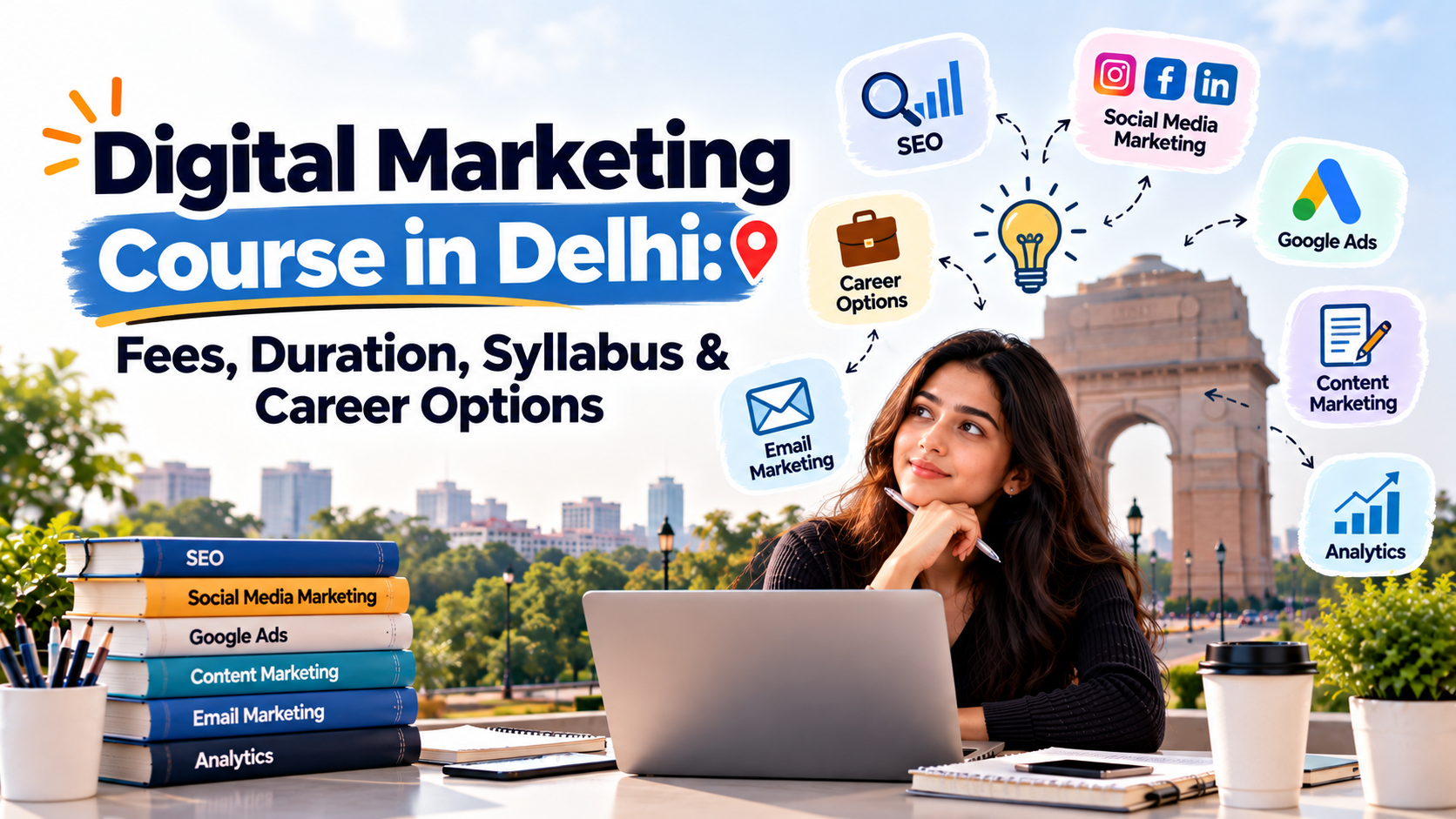
Digital Marketing Course in Delhi: Fees, Duration, Syllabus & Career Options
Digital marketing has become an important skill for businesses, brands, startups, and professionals that want to build a strong online presence. Search engines, social media, paid advertising, content, email campaigns, analytics, and AI tools are now part of many digital marketing strategies.
Because of this, students, fresh graduates, working professionals, entrepreneurs, and career changers are exploring a digital marketing course in Delhi to develop practical knowledge and understand different areas of online marketing.
This guide covers course fees, duration, syllabus, practical projects, learning formats, eligibility, career options, and the factors you should compare before enrolling.
Digital Marketing Course at a Glance
If you are comparing digital marketing courses in Delhi, start with the practical details before comparing promotional claims.
- Duration: 3 months / 12 weeks
- Learning mode: Live online and classroom training
- Classroom location: Rajouri Garden, New Delhi
- AI tools: 12+ tools
- Live projects: 8+ industry projects
- Practical assignments: 20+
What Is a Digital Marketing Course?
A digital marketing course is a structured training program that teaches learners how businesses promote products, services, and brands through online channels.
Depending on the program, learners may study SEO, social media marketing, paid advertising, content marketing, email marketing, analytics, lead generation, conversion optimisation, and marketing automation.
Modern programs may also introduce AI-powered tools for activities such as content creation, research, campaign planning, customer analysis, and productivity.
A good digital marketing learning program should combine concepts with practical application so learners understand how different marketing channels work together.
Why Consider a Digital Marketing Course in Delhi?
Delhi and the wider NCR region include startups, agencies, e-commerce businesses, service companies, educational organisations, technology companies, and established brands. This creates different types of marketing work and learning opportunities.
For students and freshers, structured training can provide a learning roadmap instead of requiring them to study unrelated topics from multiple sources. Working professionals can use training to strengthen their existing marketing knowledge or explore a new specialisation.
For learners considering classroom training, the Upskill Now centre referenced in this article is located in Rajouri Garden, New Delhi. Live online training is also available for learners who need flexibility alongside college or work.
Digital Marketing Course Fees in Delhi
One of the first questions learners ask is about digital marketing course fees in Delhi. There is no single fee for every institute because pricing can depend on the curriculum, learning format, projects, mentorship, tools, and career support included.
For the AI Digital Marketing Master Program referenced in this article, the current Upskill Now course page lists ₹30,000 for online training and ₹45,000 for offline classroom training. These listed prices should be rechecked before enrolment because fees and offers can change.
Course duration, number of modules, trainer experience, practical assignments, project work, tools covered, and additional services can also influence the overall fee.
Instead of selecting a course simply because it is inexpensive, compare what is included in the fee. Check whether the program provides live classes, practical assignments, projects, AI tool training, certification, mentorship, internship support, and career assistance.
Before enrolling, confirm the complete fee structure and whether there are additional charges for certifications, examinations, software, projects, or other services.
How Long Does a Digital Marketing Course Take?
The duration of a digital marketing course varies depending on its depth and structure. Short-term programs may focus on fundamental concepts, while comprehensive programs can provide broader exposure to multiple marketing channels and practical applications.
A beginner-oriented course may take a few months, while advanced programs can extend for longer periods. Actual learning time also depends on how much practice you complete outside classroom or online sessions.
When comparing course duration, do not assume that a longer course automatically provides better learning. Instead, examine what is taught during that period and how much practical work is included.
Digital Marketing Course Syllabus
The syllabus is one of the most important factors to examine before enrolling. Since digital marketing includes several disciplines, a complete learning path should introduce the fundamentals before moving into specialised areas.
Search Engine Optimization
SEO helps businesses improve their visibility in search engine results. A beginner syllabus may introduce keyword research, on-page optimisation, technical SEO fundamentals, content optimisation, internal linking, backlinks, local SEO, and performance monitoring.
Students should also understand search intent and why SEO is generally a long-term marketing activity rather than a one-time task.
Social Media Marketing
Social media marketing focuses on platforms such as Instagram, Facebook, LinkedIn, YouTube, and other relevant channels to build awareness, engagement, and customer relationships.
Students can learn content planning, audience research, platform-specific content, social media calendars, engagement strategies, and basic campaign measurement.
Google Ads and Paid Advertising
Paid advertising introduces learners to search advertising, display campaigns, audience targeting, campaign structure, keyword selection, ad copy, budgeting, conversion tracking, and performance analysis.
Understanding paid advertising helps learners see how businesses can reach specific audiences and measure campaign performance.
Content Marketing
Content marketing covers formats such as blog content, website copy, social media content, landing pages, video content, and other material used to attract and engage audiences.
A good course should also explain how content connects with SEO, social media, lead generation, and the customer journey.
Email Marketing
Email marketing involves communicating with customers and leads through targeted campaigns. Topics may include email lists, campaign planning, newsletters, automation, personalisation, subject lines, and basic performance metrics.
Web Analytics
Analytics helps marketers understand how visitors interact with websites and campaigns. Learners should become familiar with traffic sources, engagement, conversions, campaign performance, and user behaviour.
Lead Generation
Digital marketing is not only about generating website traffic. Businesses also need qualified leads and customers. Lead generation can introduce landing pages, forms, calls to action, campaigns, audience targeting, and conversion-focused strategies.
AI in Digital Marketing
AI is increasingly being incorporated into marketing workflows. Depending on the program, learners may explore AI tools for content ideation, research, copywriting assistance, campaign planning, customer analysis, automation, and productivity.
The focus should be on using AI responsibly while maintaining human judgement, originality, accuracy, and brand consistency.
AI tools commonly included in the AI-focused digital marketing program referenced in this article include ChatGPT, Google Gemini, Claude AI, Canva AI, Midjourney, Copy.ai, Jasper AI, Pictory, Synthesia, Notion AI, Runway ML, and Grammarly AI.
Practical Projects and Skills You Can Develop
Practical work can make a significant difference in how effectively you understand digital marketing. Reading about SEO, advertising, analytics, or social media is different from planning and executing a campaign.
A practical course may include projects such as creating an SEO strategy, developing a content calendar, planning a social media campaign, preparing a paid advertising structure, analysing website performance, or creating a complete digital marketing plan.
Alongside technical skills, learners should develop communication, analytical thinking, writing, creativity, attention to detail, and problem-solving abilities.
These skills are useful because digital marketers often work with clients, designers, developers, sales teams, and business owners while also interpreting campaign and website data.
If you are considering an AI-focused marketing course, also check whether practical AI applications are included rather than only mentioning AI as a topic in the syllabus.
Who Can Join a Digital Marketing Course?
Digital marketing can be learned by people from different educational and professional backgrounds. You do not necessarily need an advanced technical background to begin.
- Students: Can learn digital marketing alongside their academic education and use projects to develop practical experience.
- Fresh graduates: Can develop industry-oriented skills and explore entry-level marketing opportunities.
- Working professionals: Can strengthen existing marketing, sales, communication, or business development skills.
- Entrepreneurs: Can learn how websites, social media, search engines, advertising, and content contribute to customer acquisition.
- Career switchers: Can use structured training to build foundational knowledge before choosing a specialisation.
Career Options After Digital Marketing Training
Digital marketing includes several specialisations, so completing a course does not necessarily mean following only one career path.
SEO Specialist
SEO professionals work on improving organic search visibility through keyword research, content optimisation, technical improvements, internal linking, and performance analysis.
Social Media Executive
Social media professionals manage content planning, publishing, engagement, community interaction, and social media campaigns for brands and organisations.
Content Marketing Executive
Content marketers create and manage content designed to attract audiences, support SEO, communicate brand messages, and contribute to business goals.
Performance Marketing Executive
Performance marketers work with paid advertising campaigns and focus on metrics such as clicks, conversions, leads, acquisition costs, and return on advertising spend.
Email Marketing Specialist
Email marketing professionals plan campaigns, newsletters, customer communication, segmentation, and automated email workflows.
Digital Marketing Executive
A digital marketing executive may work across several channels rather than specialising in only one area. The role can involve SEO, social media, content, advertising, analytics, and campaign coordination.
Freelance Digital Marketer
Digital marketing skills can also be used for freelance work. Freelancers may provide services such as SEO, social media management, content marketing, paid advertising, website optimisation, or analytics support.
Online vs Classroom Digital Marketing Courses
Both classroom and online learning can work effectively when the course is well structured.
Classroom learning may suit students who prefer direct interaction with trainers and a fixed learning schedule. It can also provide opportunities to interact with other learners and discuss projects in person.
Online learning may be more convenient for working professionals, students with busy schedules, or learners who prefer studying from home. Live online classes can provide interaction while maintaining greater flexibility.
When choosing between the two, consider your schedule, preferred learning environment, access to trainers, practical support, and ability to remain consistent with self-study.
For Delhi learners, classroom training at Rajouri Garden may suit those who prefer face-to-face interaction, while live online training can be more convenient for students and working professionals who need flexibility.
How to Choose the Right Digital Marketing Course in Delhi
Before enrolling, compare courses based on the actual learning experience rather than promotional claims.
- Check the syllabus: Make sure the course covers the areas you want to learn, including SEO, social media, paid advertising, content, analytics, email marketing, and AI where relevant.
- Review practical training: Check the number and type of assignments, projects, and case studies included.
- Understand the trainers: Look for instructors who can explain concepts clearly and connect theory with practical marketing situations.
- Compare learning formats: Consider classroom and online schedules, trainer access, mentorship, and learner support.
- Review certifications and career support: Understand exactly what certification, internship, and placement assistance includes rather than assuming it guarantees employment.
- Compare the total fee: Check what is included and whether there are additional charges for projects, examinations, software, or certifications.
- Check AI training: Understand which AI tools are taught and whether learners actually use them for marketing tasks.
For learners who want a structured AI and digital marketing skill path, the course should be evaluated on both its traditional digital marketing curriculum and the practical use of AI within marketing workflows.
Conclusion
A digital marketing course in Delhi can provide beginners and professionals with a structured way to learn important online marketing skills. However, the value of a course depends on more than its title or certificate.
Before enrolling, carefully compare the fees, duration, syllabus, practical projects, trainers, learning format, certifications, and career support. Make sure the curriculum matches your career objective and provides sufficient opportunities to practise what you learn.
Whether you want to work in SEO, social media, content marketing, paid advertising, analytics, email marketing, or a broader digital marketing role, practical skills should remain a priority.
Digital marketing is also an evolving field. After completing formal training, continue experimenting, learning new tools, analysing campaigns, and developing your portfolio so that your skills continue to develop.
Contact Upskill Now
A-3, Third Floor, Rajouri Garden, New Delhi – 110027
Phone: 9999848160 | 9711448765
Email: connect@upskillnow.in