
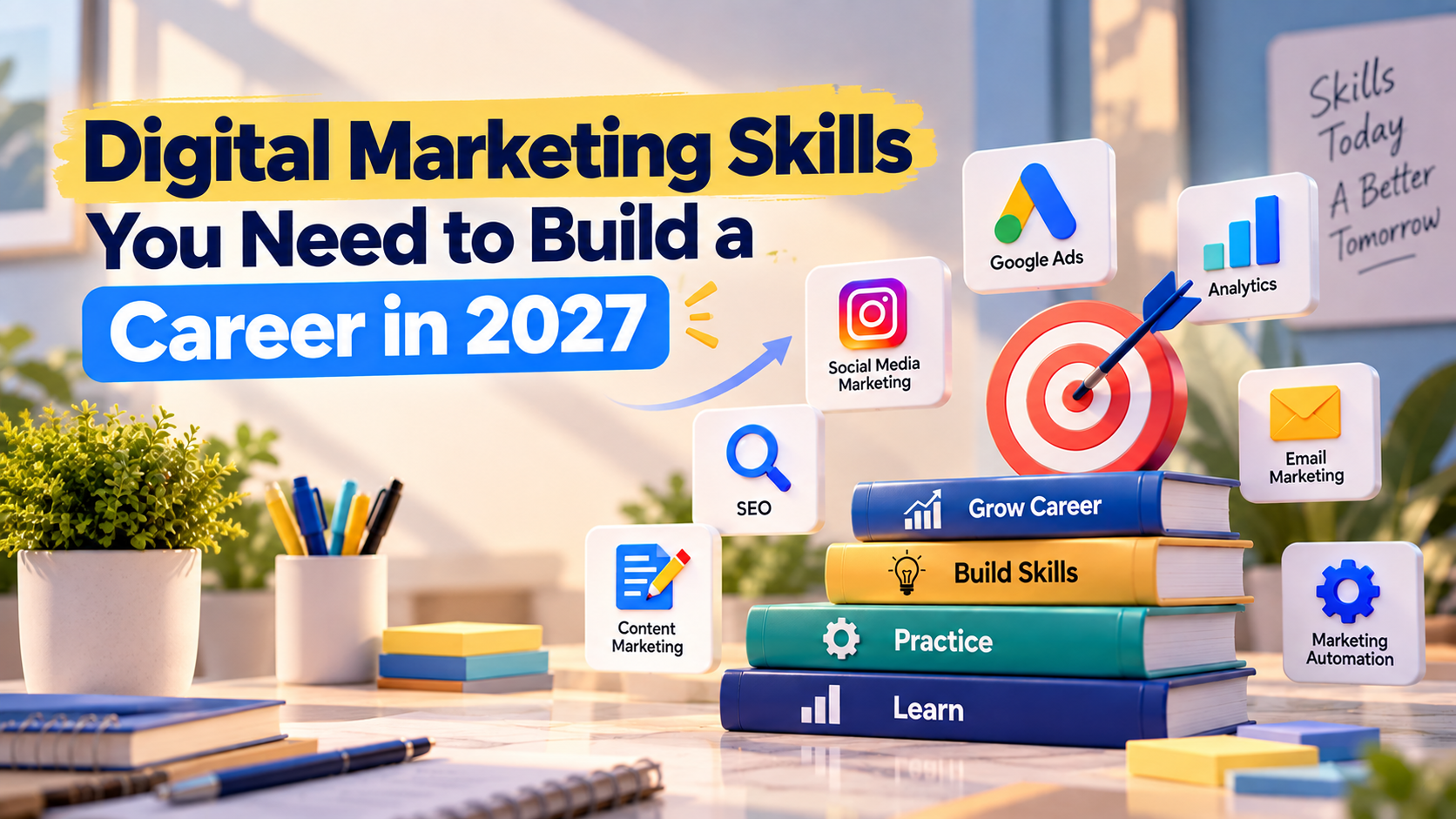
Digital Marketing Skills You Need to Build a Career in 2027
Digital marketing continues to evolve as businesses increasingly depend on search, social media, paid advertising, analytics, content, and AI-powered tools to reach customers. Building the right digital marketing skills can help beginners prepare for different roles across the digital marketing industry.
For beginners, the challenge is not only learning individual tools but also understanding how different marketing activities work together. This guide explains the digital marketing skills you need to build a career in 2027, along with practical projects, useful tools, portfolio ideas, and a structured learning path.
Digital Marketing Skills in Delhi
For beginners looking to develop digital marketing skills in Delhi, practical learning can provide exposure to SEO, content marketing, social media, paid advertising, analytics, and AI-powered marketing tools.
Learning through practical projects can also help you understand how different digital marketing channels work together and how marketing strategies are applied to real business objectives.
Why Digital Marketing Skills Matter in 2027
Digital marketing requires a combination of technical, analytical, creative, and communication skills. Marketers need to understand how audiences search for information, interact with content, respond to advertising, and move through different stages of the customer journey.
In 2027, marketers also need to understand AI-powered tools, automation, data analysis, and changing digital platforms while continuing to develop strong fundamental marketing skills.
Core Digital Marketing Skills
Digital Marketing Fundamentals
Understanding digital marketing fundamentals is the starting point for building a career in this field. Beginners should understand major areas such as SEO, social media marketing, paid advertising, email marketing, content marketing, analytics, and conversion optimisation.
A strong foundation helps marketers understand how different channels contribute to traffic, engagement, leads, conversions, and overall marketing objectives.
Before specialising in a particular area, it is useful to understand concepts such as target audiences, customer journeys, marketing funnels, search intent, landing pages, online branding, and campaign measurement.
SEO and Keyword Research
Search Engine Optimisation, commonly called SEO, is an important digital marketing skill because businesses use search engines to reach people looking for information, products, and services.
SEO is not simply about adding keywords to a webpage. It involves understanding search intent, creating useful content, improving website structure, making pages easier to navigate, and helping search engines understand the website.
Important SEO skills include:
- Keyword research
- Search intent analysis
- On-page SEO
- Technical SEO basics
- Internal linking
- Content optimisation
- Local SEO
- SEO performance analysis
Keyword research supports SEO by helping marketers identify the terms and topics their target audience is searching for. It can also help with content planning and understanding different stages of search intent.
Content Marketing and Copywriting
Content marketing involves creating and distributing useful information to attract, educate, engage, and retain an audience. Content can include blogs, videos, social media posts, guides, newsletters, case studies, and other formats.
Good content marketing starts with understanding the audience. Before creating an article or social media post, marketers should understand what problem they are trying to solve and what information the audience is looking for.
Content marketing skills include:
- Topic research
- Content planning
- Blog writing
- Copywriting
- Storytelling
- Content optimisation
- Visual content planning
- Content distribution
- Performance measurement
Copywriting focuses on communicating ideas clearly and encouraging the audience to take an intended action. Strong writing skills can help marketers create clearer headlines, advertisements, calls to action, emails, and website content.
Content marketing also connects closely with SEO and social media. A well-researched blog can attract search traffic, while parts of the same content can be adapted into social media posts, videos, newsletters, or educational graphics.
Social Media Marketing
Social media marketing focuses on using platforms such as Instagram, Facebook, LinkedIn, YouTube, and other social channels to communicate with audiences and build brand awareness.
Professional social media marketing involves more than creating posts. Marketers need to understand audience research, content planning, platform-specific strategies, community engagement, performance tracking, and campaign optimisation.
Important social media skills include:
- Audience research
- Social media strategy
- Content calendars
- Caption writing
- Short-form video strategy
- Community management
- Social media analytics
- Paid social advertising basics
Each platform can have different audience behaviour, so marketers need to understand how content and communication should be adapted to the platform being used.
Google Ads and Meta Ads
Paid advertising introduces marketers to performance marketing. Businesses can use platforms such as Google Ads and Meta Ads to reach specific audiences and support campaigns with measurable objectives.
Learning paid advertising requires more than creating an advertisement. Marketers should understand campaign objectives, keywords, audience targeting, budgets, ad formats, landing pages, conversion tracking, and performance measurement.
Important paid advertising skills include:
- Keyword selection
- Campaign structure
- Ad copywriting
- Audience targeting
- Budget management
- Conversion tracking
- Click-through rate analysis
- Cost-per-click analysis
- Campaign optimisation
Getting clicks is not the only objective of a paid campaign. Marketers also need to understand what happens after someone clicks an advertisement. A well-planned campaign connects the advertisement, landing page, offer, audience, and conversion goal.
Email Marketing
Email marketing helps businesses communicate with existing and potential customers. Digital marketers should understand email campaigns, audience segmentation, content, calls to action, and performance measurement.
Email marketing can also work with other digital marketing activities to support customer communication and retention. Understanding how email fits into the wider customer journey can help marketers create more connected campaigns.
Marketing Analytics and Measurement
Analytics skills help marketers understand whether their digital marketing activities are producing the intended results.
Marketers should be able to work with metrics related to traffic, engagement, conversions, campaigns, and other performance indicators. Google Analytics and Google Search Console can help marketers analyse website and search performance.
Analytics can also help marketers identify patterns, evaluate campaigns, compare performance, and make decisions based on measurable information instead of assumptions.
AI, Prompt Engineering and Marketing Automation
AI-powered digital marketing is becoming an important part of modern marketing workflows. Marketers can use AI tools to support activities such as research, content creation, campaign planning, analysis, idea generation, and workflow development.
AI-Powered Digital Marketing Skills can also include prompt engineering, where marketers create effective instructions for AI tools to produce useful outputs for specific marketing tasks.
Marketing automation can help streamline repetitive activities and support workflows involving communication, campaigns, lead management, and reporting. The goal is to use automation as part of a marketing workflow rather than treating individual AI or automation tools as isolated skills.
Conversion Rate Optimisation
Conversion Rate Optimisation, or CRO, focuses on improving the percentage of visitors who complete a desired action on a website or landing page.
Marketers should understand how page structure, content, calls to action, forms, and user experience can affect conversions.
CRO can work alongside SEO, paid advertising, content, and analytics because increasing traffic is only one part of digital marketing. The quality of the visitor experience also matters when the objective is to generate a desired action.
Data-Driven Decision Making
Digital marketers need to use available performance data when evaluating campaigns and deciding what to improve.
Data-driven decision making involves analysing results, identifying opportunities, comparing performance, and using measurable information to guide marketing activities.
Developing this skill can help marketers move beyond simply reporting numbers and instead use performance information to understand what is working and what may need improvement.
Soft Skills for Digital Marketers
Communication Skills
Digital marketers regularly communicate with clients, teams, customers, designers, developers, and other professionals. Clear written and verbal communication helps marketers explain ideas, campaigns, results, and recommendations.
Creative Thinking
Creative thinking helps marketers develop new content ideas, campaign concepts, messaging, and approaches to audience engagement.
Problem-Solving Skills
Digital marketing campaigns may face challenges involving traffic, engagement, conversions, advertising performance, or content. Problem-solving skills help marketers identify issues and develop practical solutions.
Adaptability and Continuous Learning
Digital platforms, tools, algorithms, and marketing practices continue to change. Marketers need to keep learning and adapt their skills as new technologies and approaches become part of digital marketing.
Practical Projects and Portfolio
Practical projects can help beginners apply digital marketing concepts instead of only learning theory. Projects can cover activities such as creating an SEO plan, developing a content strategy, planning a social media campaign, setting up an advertising campaign, or analysing marketing performance.
For example, you could perform a basic website audit and create a keyword research document for SEO. For social media, you could develop a content calendar and analyse engagement. For paid advertising, you could create a sample campaign structure and calculate potential performance metrics.
These projects can also become part of a digital marketing portfolio. Instead of simply listing skills on a resume, you can demonstrate what you created, the objective of the project, the tools you used, and what you learned.
Building a portfolio around practical work can help demonstrate your ability to connect marketing strategy with execution.
Tools Digital Marketers Should Know
Digital marketers work with many different tools, but beginners do not need to master every platform immediately.
For SEO, you can learn tools used for keyword research, website audits, search performance, and competitor research. For paid advertising, learn the Google Ads and Meta Ads interfaces and understand campaign reporting.
For social media, explore tools for scheduling, analytics, content management, and campaign planning. Analytics tools are also important because marketing decisions should be based on measurable information.
As you progress, you can also explore AI tools, marketing automation, email marketing, conversion optimisation, and other specialised areas.
How to Build Digital Marketing Skills in Delhi
Beginners can develop digital marketing skills by combining structured learning with practical application. A learning approach can include understanding the fundamentals first, developing individual channel skills, working on practical projects, and analysing the results.
For learners in Delhi, practical training can also provide opportunities to work on projects and understand how digital marketing activities are applied in real-world situations.
The focus should be on developing an understanding of marketing concepts and then applying them through practical work rather than trying to memorise every platform or tool.
Digital Marketing Career Paths for Beginners
Digital marketing skills can support different career paths depending on a person's interests and strengths. Beginners can explore roles such as:
- SEO Executive
- Content Marketing Executive
- Social Media Executive
- Performance Marketing Executive
- Email Marketing Executive
- Digital Marketing Executive
- Marketing Analytics roles
- Digital Marketing Specialist
Some professionals may also use their digital marketing skills to work independently as freelancers or provide marketing services to businesses.
The combination of broad digital marketing knowledge and deeper expertise in one or more areas can help learners explore different types of roles.
How to Start Learning Digital Marketing in 2027
If you are completely new to digital marketing, trying to learn every platform at the same time can become confusing. A structured learning path can make the process easier.
- Understand digital marketing fundamentals.
- Learn how websites, search engines, and audiences interact.
- Build basic SEO and keyword research knowledge.
- Learn content marketing and copywriting.
- Understand social media marketing.
- Learn the fundamentals of Google Ads and Meta Ads.
- Study analytics and campaign measurement.
- Develop AI, prompt engineering, and automation skills.
- Practise through real or simulated projects.
- Create a portfolio showing your work.
- Gradually specialise in the area you want to explore further.
A structured digital marketing learning path can help beginners connect these different areas instead of learning isolated tools without understanding how they fit into a campaign.
Why Practical Training Matters
Reading about digital marketing concepts is useful, but practical work helps you understand how those concepts operate in real situations.
Working on projects can help you practise research, content creation, campaign planning, analytics, optimisation, and reporting. It can also make it easier to identify areas where you need additional learning.
Practical experience becomes particularly useful when you are building a portfolio because it gives you examples of work that can demonstrate your skills.
Common Mistakes to Avoid
Beginners can make their learning more effective by avoiding some common mistakes. These include focusing only on theory, trying to learn every tool at once, ignoring analytics, and not creating practical projects.
Another common mistake is treating digital marketing as a fixed skill set. Platforms, technologies, tools, and marketing practices continue to develop, so continuous learning remains important.
It is also useful to understand the purpose behind a marketing activity instead of focusing only on how to operate a particular tool.
Build a Complete Digital Marketing Skill Set
Learning digital marketing is not about memorising every platform or becoming an expert in every channel immediately. The goal is to understand how different marketing activities contribute to a common business objective.
Start with the fundamentals, develop working knowledge of SEO, content marketing, social media, paid advertising, analytics, email marketing, and AI-powered marketing, and then use practical projects to strengthen your skills.
If you are looking for structured learning, an AI digital marketing course can help you explore how modern marketing workflows incorporate AI-assisted research, content creation, analytics, and automation.
Conclusion
Building a career in digital marketing in 2027 requires a combination of technical knowledge, analytical thinking, creativity, communication, and practical experience.
Core skills such as SEO, keyword research, content marketing, social media, paid advertising, email marketing, analytics, AI, automation, and conversion optimisation can provide a strong foundation.
Developing these skills through practical projects and building a portfolio can help beginners demonstrate what they can do. With continuous learning and hands-on experience, digital marketers can develop the skills needed to explore different areas of the digital marketing industry.
Address: A-3, Third Floor, Rajouri Garden, New Delhi – 110027
Phone: 9999848160 | 9711448765
Email: connect@upskillnow.in