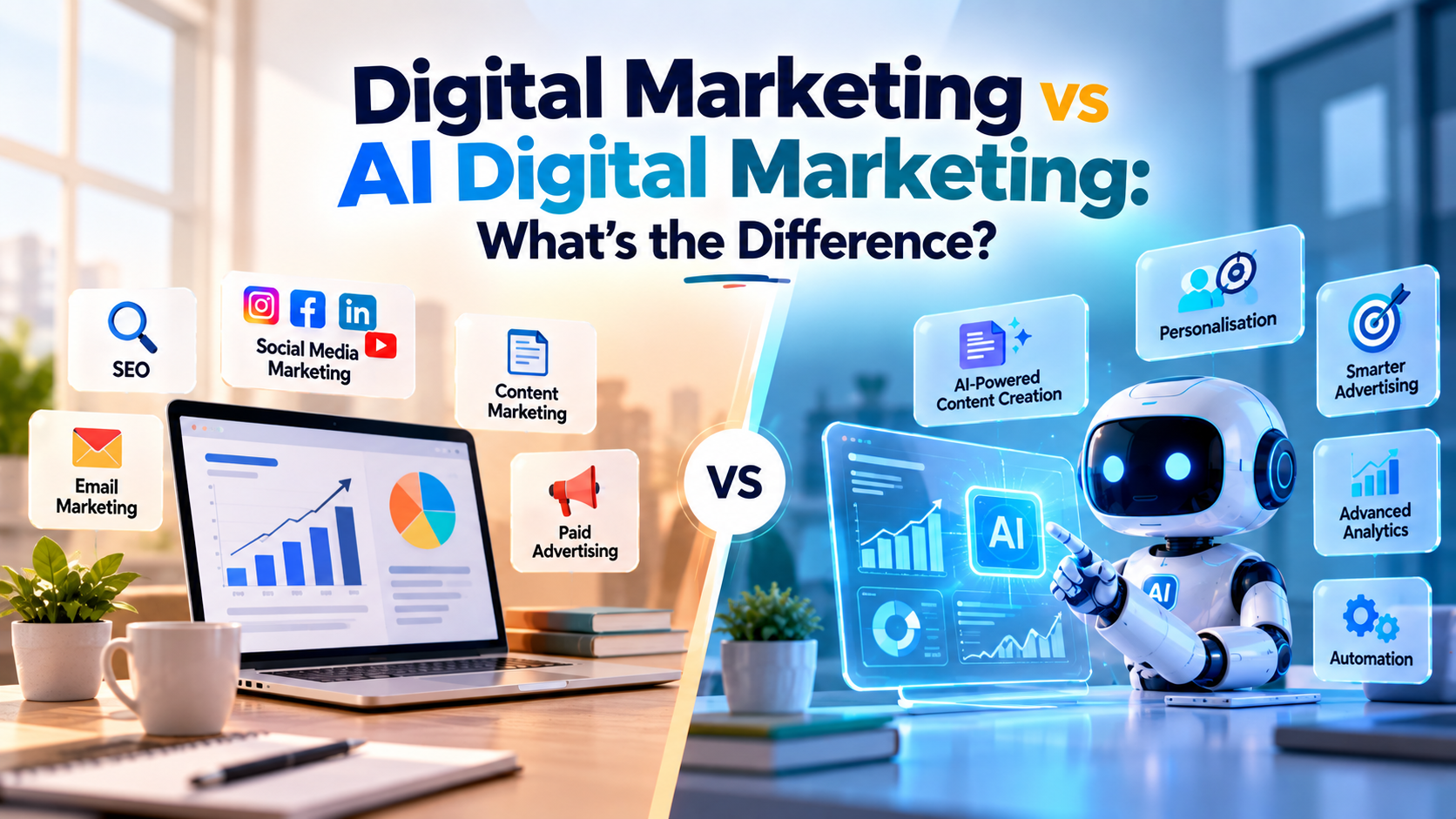
Digital Marketing vs AI Digital Marketing: What's the Difference?
Digital marketing has become an essential part of how businesses attract customers, build brand awareness, and generate leads online. Search engines, social media, email campaigns, paid advertising, websites, and analytics platforms allow businesses to reach specific audiences and measure their marketing activities.
However, the way digital marketing is planned and executed is changing with the use of artificial intelligence. AI can assist marketers with content creation, customer analysis, SEO research, personalisation, campaign optimisation, reporting, and repetitive marketing tasks.
This creates an important question for students, professionals, and businesses: what is the difference between digital marketing and AI digital marketing?
Understanding the difference can help you identify which marketing skills remain important and where AI can be incorporated into existing workflows.
What Is Digital Marketing?
Digital marketing refers to promoting products, services, or brands through online channels. It includes activities such as search engine optimisation, social media marketing, content marketing, email marketing, paid advertising, and website optimisation.
A digital marketer studies the target audience, develops marketing strategies, creates campaigns, publishes content, manages advertising platforms, and analyses campaign performance.
The goal is not simply to generate online visibility. Effective digital marketing connects the right audience with relevant content, products, or services and guides potential customers through the buying journey.
What Is AI in Digital Marketing?
AI in digital marketing means using artificial intelligence technologies to support different stages of the marketing process. Instead of relying entirely on manual research, content creation, analysis, and optimisation, marketers can use AI-powered tools to process information and assist with specific tasks.
AI can help generate content ideas, analyse customer behaviour, identify patterns in campaign data, personalise communication, create advertising variations, and automate repetitive activities.
For example, a marketer could use AI to create several versions of an advertising message, analyse audience interactions, or turn a long-form article into multiple social media posts.
AI does not remove the need for marketing strategy. Marketers still need to define objectives, understand customers, maintain brand identity, review information, and decide which recommendations should actually be implemented.
Digital Marketing vs AI Digital Marketing
The main difference between digital marketing and AI digital marketing is the role artificial intelligence plays in the workflow.
Traditional digital marketing relies more heavily on manual research, planning, content development, campaign management, and performance analysis. AI digital marketing adds AI-powered tools to these processes to help marketers work with information, automate repetitive activities, generate variations, and identify potential patterns more efficiently.
In simple terms, digital marketing provides the strategy and marketing activities, while AI can provide additional assistance, automation, analysis, and personalisation within those activities.
AI digital marketing is therefore not a completely separate replacement for digital marketing. It is an approach that combines established marketing principles with AI-supported workflows.
How AI Changes Digital Marketing
Content Creation
Traditional content marketing involves researching a topic, creating an outline, writing content, editing it, preparing visuals, and publishing it across different channels.
AI tools can assist with brainstorming, outlines, content variations, captions, email drafts, product descriptions, and other marketing content.
However, AI-generated content still requires human review for accuracy, originality, brand voice, relevance, and quality. A practical AI digital marketing course can help learners understand how AI fits into content and marketing workflows.
SEO and Search Marketing
SEO traditionally requires keyword research, competitor analysis, search-intent research, website optimisation, content planning, and performance monitoring.
AI can assist with identifying content ideas, organising keywords, analysing information, suggesting content structures, and finding potential optimisation opportunities.
Human understanding remains important because search intent, audience expectations, website quality, content usefulness, and overall strategy cannot be reduced to a single automated recommendation.
Audience Research and Personalisation
Understanding customers is fundamental to digital marketing. Marketers can analyse surveys, website behaviour, campaign reports, social interactions, and other sources of customer information.
AI can process larger amounts of information and help identify patterns or audience segments. This can support more relevant marketing messages and personalised customer journeys.
Personalisation can be applied to emails, websites, product recommendations, advertisements, and other customer interactions.
Digital Advertising
Paid advertising requires marketers to select audiences, create advertisements, establish budgets, monitor performance, and make optimisation decisions.
Advertising platforms increasingly use AI and machine learning to assist with audience targeting, bidding, creative testing, and campaign optimisation.
Marketers can therefore spend more time defining objectives, reviewing performance, developing appropriate creative assets, and making strategic decisions rather than manually adjusting every campaign element.
Social Media and Email Marketing
Social media marketing traditionally involves researching topics, creating posts, preparing captions, scheduling content, responding to audiences, and measuring engagement. Email marketing similarly involves creating subject lines, writing messages, managing subscriber lists, scheduling campaigns, and analysing results.
AI can support these activities by generating content ideas, adapting content for different platforms, creating subject-line variations, personalising messages, identifying engagement patterns, and helping marketers repurpose existing content.
Human creativity, communication, audience understanding, and brand direction remain important for both channels.
Marketing Analytics
Traditional marketing analytics requires marketers to review dashboards, traffic sources, conversion data, campaign performance, and other metrics.
AI can help identify patterns, highlight unusual changes, summarise performance information, and support predictive analysis. This can allow marketers to spend more time interpreting results and deciding what action to take.
Skills Needed for AI Digital Marketing
AI is changing the tools marketers use, but it does not eliminate the need for fundamental digital marketing knowledge. Understanding the basics is important because marketers need to evaluate whether an AI-generated recommendation makes sense.
Core skills include SEO, content marketing, social media marketing, paid advertising, analytics, email marketing, audience research, conversion optimisation, and marketing strategy.
Alongside these fundamentals, marketers can develop skills such as prompt writing, AI-assisted content creation, AI-powered research, data interpretation, workflow automation, and AI-supported campaign optimisation.
Learning these areas together creates a practical AI-powered digital marketing skill set rather than treating AI as a completely separate technology.
Benefits of Combining Digital Marketing with AI
Combining digital marketing knowledge with AI tools can provide several practical advantages.
- Less repetitive work: AI can assist with routine research, content variations, reporting, and other repetitive activities.
- Faster analysis: AI can help process larger amounts of information and identify patterns that require further attention.
- More experimentation: Marketers can create and compare different versions of content, advertisements, subject lines, and messages.
- Scalable personalisation: AI can support more relevant communication across different audience segments.
These benefits do not remove the need for marketing strategy. They can instead give marketers more time to focus on customer understanding, creative thinking, planning, and decision-making.
Challenges of AI Digital Marketing
AI also introduces challenges that marketers need to understand.
AI-generated content may contain inaccurate or unsuitable information, while generic outputs can make different brands sound similar. AI systems can also produce recommendations based on incomplete or poor-quality information.
Data privacy is another consideration when marketing systems use customer information. Businesses need to understand how data is collected, stored, processed, and used.
Over-automation can also become a problem. Marketing decisions should not be handed over to technology without appropriate human review, particularly when decisions affect customers, brand reputation, or business spending.
Does AI Digital Marketing Replace Digital Marketing?
No. AI digital marketing is better understood as an evolution of digital marketing rather than a completely separate field.
The core principles of marketing remain important: understanding customers, creating valuable offers, communicating clearly, building trust, selecting suitable channels, and measuring business results.
AI adds another layer to these activities. It can help marketers analyse information, automate repetitive work, create variations, support personalisation, and identify potential opportunities faster.
The marketer remains responsible for deciding what the brand should communicate, who it should communicate with, why the message matters, and whether the final output meets the required standards.
How Beginners Can Learn AI Digital Marketing
Beginners should first understand the fundamentals of digital marketing before relying heavily on AI tools.
Learning SEO without understanding search intent, or using AI content tools without knowing what makes useful content, can lead to ineffective marketing. Similarly, using AI advertising features without understanding audiences, budgets, conversions, and campaign objectives can make it difficult to evaluate results.
A practical learning path should combine digital marketing fundamentals with AI applications. Once the basics are clear, learners can experiment with AI for research, content, SEO, advertising, social media, analytics, and automation.
The objective should be to use AI as part of a marketing workflow rather than as a shortcut for learning marketing itself. A structured AI marketing learning program can help learners connect these skills through practical applications.
How Digital Marketers Can Prepare for the AI Era
Digital marketers do not need to learn every AI tool available. A better approach is to understand the marketing problem first and then identify where AI can provide useful support.
Strengthen core digital marketing knowledge, practise real marketing tasks, and learn how AI can support specific areas such as SEO, content creation, paid advertising, analytics, email marketing, and social media.
Practical experimentation is important because marketers need to evaluate not only what an AI tool can produce, but also whether the result is accurate, useful, relevant, and appropriate for the intended audience.
A combination of marketing strategy, analytical thinking, creativity, and AI literacy can help professionals adapt as marketing technology continues to evolve.
Conclusion
Digital marketing and AI digital marketing are closely connected. Digital marketing provides the strategy, channels, audience understanding, and marketing fundamentals, while AI adds capabilities that can support research, content creation, personalisation, analytics, automation, SEO, advertising, and campaign optimisation.
The difference is therefore not about choosing between two completely separate fields. AI is becoming part of the digital marketing toolkit, while the underlying principles of marketing continue to guide how those tools are used.
For students and professionals, learning both digital marketing fundamentals and practical AI skills can provide a more complete understanding of how modern marketing workflows are changing.
Contact Upskill Now
A-3, Third Floor, Rajouri Garden, New Delhi – 110027
Phone: 9999848160 | 9711448765
Email: connect@upskillnow.in