Secondary Keywords:
- full stack developer roadmap
- full stack developer skills
- full stack development technologies
- how to become a full stack developer
- full stack developer career scope
- full stack developer skills in 2026
- full stack web development roadmap
Introduction
Full stack development is one of the most versatile areas of web development because it combines front-end development, back-end development, databases, APIs, deployment, and development tools.
For beginners, understanding what to learn and in what order can make the learning process easier. This Full Stack Developer Roadmap 2026 explains the essential skills, technologies, and career scope for aspiring full stack developers.
What Is a Full Stack Developer?
A full stack developer works on both the front end and back end of a web application.
The front end is the part users interact with, while the back end handles application logic, databases, APIs, authentication, and server-side operations.
A full stack developer may work with:
- HTML
- CSS
- JavaScript
- React
- Node.js
- Express.js
- Python
- Databases
- APIs
- Git and GitHub
- Cloud and deployment technologies
Full Stack Developer Roadmap 2026
A practical roadmap can be divided into several stages:
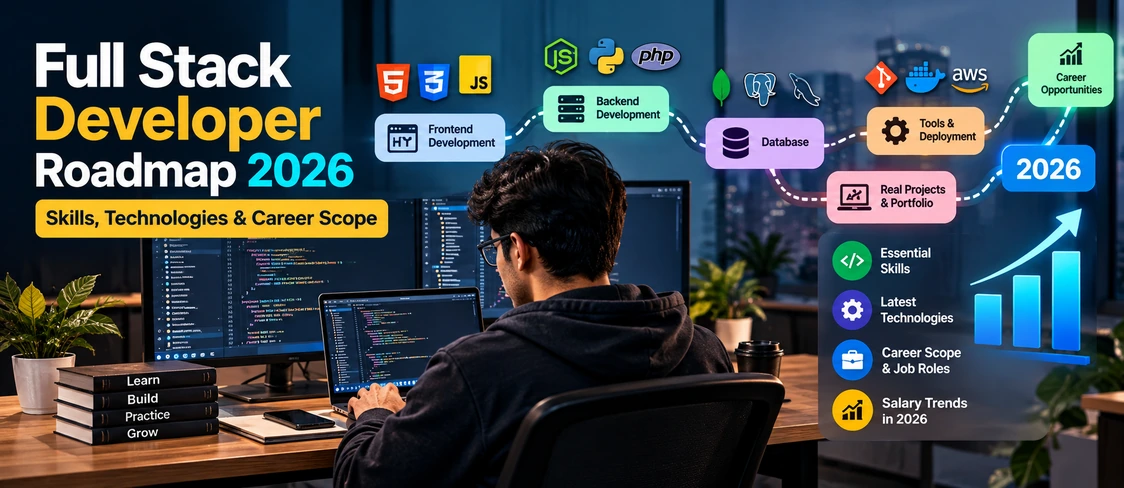
HTML & CSS → JavaScript → Front-End Framework → Back-End Development → Databases → APIs → Git & GitHub → Testing → Deployment → Projects
Each stage builds on the previous one.
1. Learn HTML
HTML is the foundation of web development.
Start by learning:
- HTML elements
- Headings and paragraphs
- Links
- Images
- Lists
- Tables
- Forms
- Semantic HTML
- HTML5 features
A strong understanding of HTML helps you create the structure of web pages.
2. Learn CSS
After HTML, learn CSS to create attractive and responsive websites.
Important CSS concepts include:
- Selectors
- Colors
- Typography
- Box model
- Flexbox
- CSS Grid
- Positioning
- Responsive design
- Media queries
- Animations
- Transitions
Responsive design is especially important because websites need to work across different screen sizes.
3. Learn JavaScript
JavaScript is one of the most important programming languages for modern web development.
Focus on:
- Variables
- Data types
- Functions
- Arrays
- Objects
- Loops
- Conditions
- DOM manipulation
- Events
- ES6+ features
- Promises
- Async/await
- Error handling
- Fetch API
Once you understand JavaScript fundamentals, you can move toward modern front-end frameworks.
4. Learn a Front-End Framework
After learning JavaScript, choose a modern front-end framework or library.
React is one commonly used option for building interactive user interfaces.
Important concepts include:
- Components
- Props
- State
- Hooks
- Events
- Forms
- Routing
- API integration
- State management
You can also explore other front-end technologies depending on your career goals.
5. Learn Back-End Development
Back-end development handles the server-side functionality of an application.
One popular JavaScript-based route is:
Node.js + Express.js
Learn concepts such as:
- Servers
- Routing
- Middleware
- Authentication
- Authorization
- Error handling
- REST APIs
- Server-side logic
- Environment variables
Other back-end technologies you can explore include Python, Java, PHP, and other server-side languages.
6. Learn Databases
Web applications need databases to store and retrieve information.
Learn both major database concepts:
SQL Databases
Examples include:
- MySQL
- PostgreSQL
Learn:
- Tables
- Rows and columns
- Relationships
- SQL queries
- Joins
- Indexes
NoSQL Databases
Examples include:
- MongoDB
Learn:
- Documents
- Collections
- CRUD operations
- Data modeling
Understanding database fundamentals is an important part of full stack development.
7. Learn APIs
APIs allow different applications and services to communicate with each other.
Learn:
- REST APIs
- HTTP methods
- GET
- POST
- PUT
- PATCH
- DELETE
- JSON
- API authentication
- API error handling
You should be able to connect your front-end application with your back-end services.
8. Learn Git and GitHub
Version control is an essential skill for modern developers.
Learn common Git concepts such as:
- Git repositories
- Commits
- Branches
- Merging
- Pull requests
- Cloning
- Pushing and pulling
- GitHub collaboration
Git helps developers track changes and work effectively with teams.
9. Learn Authentication and Security Basics
Full stack developers should understand basic web application security.
Important topics include:
- Authentication
- Authorization
- Password protection
- Sessions
- Tokens
- JWT
- HTTPS
- Input validation
- API security
- Environment variables
Security should be considered throughout the development process rather than added only at the end.
10. Learn Testing and Debugging
Testing helps developers identify problems before applications reach users.
Learn the basics of:
- Unit testing
- Integration testing
- API testing
- Debugging
- Browser developer tools
- Error handling
You don't need to master every testing framework immediately, but you should understand how testing fits into software development.
11. Learn Deployment
Building an application is only one part of full stack development. You should also understand how applications are deployed.
Learn the basics of:
- Hosting
- Domains
- Environment variables
- Build processes
- Cloud platforms
- CI/CD concepts
- Server deployment
You can gradually explore cloud technologies as your projects become more advanced.
12. Build Real-World Projects
Projects are one of the most important parts of a full stack developer roadmap.
Start with simple projects and gradually increase their complexity.
Beginner Projects
- Personal portfolio
- To-do application
- Calculator
- Blog website
- Landing page
Intermediate Projects
- E-commerce website
- Blog management system
- Authentication application
- Expense tracker
- Job portal
Advanced Projects
- Full-stack SaaS application
- Real-time chat application
- Learning management system
- Booking platform
- AI-powered web application
Projects allow you to apply your knowledge and demonstrate your development skills.
Full Stack Developer Skills in 2026
A full stack developer should develop a combination of technical and professional skills.
Technical Skills
- HTML
- CSS
- JavaScript
- Front-end frameworks
- Back-end development
- Databases
- APIs
- Git and GitHub
- Testing
- Deployment
- Web security
Professional Skills
- Problem-solving
- Communication
- Teamwork
- Time management
- Debugging
- Logical thinking
- Continuous learning
Full Stack Developer Technologies in 2026
A possible modern technology stack includes:
Front End: HTML, CSS, JavaScript, React
Back End: Node.js, Express.js
Database: PostgreSQL, MySQL, MongoDB
Version Control: Git, GitHub
APIs: REST APIs
Deployment: Cloud and hosting platforms
The exact technology stack can vary depending on the company, project, and developer's specialization.
Full Stack Developer Career Scope
Full stack development can lead to several technology career paths.
Potential roles include:
- Full Stack Developer
- Front-End Developer
- Back-End Developer
- Web Developer
- Software Developer
- JavaScript Developer
- React Developer
- Node.js Developer
With experience, developers can also move toward senior development, technical leadership, architecture, or specialized engineering roles.
How to Become a Full Stack Developer in 2026
A practical path is:
Step 1: Learn HTML and CSS
Step 2: Master JavaScript
Step 3: Learn a front-end framework
Step 4: Learn back-end development
Step 5: Learn databases
Step 6: Understand APIs
Step 7: Learn Git and GitHub
Step 8: Learn security and testing basics
Step 9: Learn deployment
Step 10: Build real-world projects
Step 11: Create a developer portfolio
Step 12: Apply for internships and entry-level opportunities
Common Mistakes to Avoid
When following a full stack developer roadmap, avoid:
- Learning too many technologies at once
- Skipping JavaScript fundamentals
- Focusing only on tutorials
- Not building projects
- Ignoring databases
- Avoiding Git
- Not learning debugging
- Copying projects without understanding them
- Neglecting responsive design
- Stopping after learning one framework
FAQs
What is a Full Stack Developer Roadmap?
A full stack developer roadmap is a structured learning path covering front-end development, back-end development, databases, APIs, version control, testing, deployment, and practical projects.
What skills should a full stack developer learn in 2026?
Important skills include HTML, CSS, JavaScript, front-end frameworks, back-end development, databases, APIs, Git, testing, deployment, and basic web security.
Is JavaScript important for full stack development?
Yes. JavaScript is widely used for front-end development and can also be used on the back end through technologies such as Node.js.
Which projects should a beginner build?
Beginners can start with a portfolio website, to-do application, blog, expense tracker, or simple e-commerce project before progressing to larger applications.
How long does it take to become a full stack developer?
The learning time varies depending on your previous programming knowledge, learning schedule, practice, and project experience. Consistent hands-on practice is important.
Conclusion
The Full Stack Developer Roadmap 2026 starts with the fundamentals of HTML, CSS, and JavaScript and gradually moves into front-end frameworks, back-end development, databases, APIs, Git, testing, security, and deployment.
The most effective way to learn full stack development is to combine structured learning with consistent practice and real-world projects. Building and deploying your own applications can help you develop practical skills and prepare for full stack development career opportunities.
📞 Call: 9999848160 | 9711448765
📍 Address: A-3, Third Floor, Rajouri Garden, New Delhi – 110027