How AI Is Changing Digital Marketing in 2027?
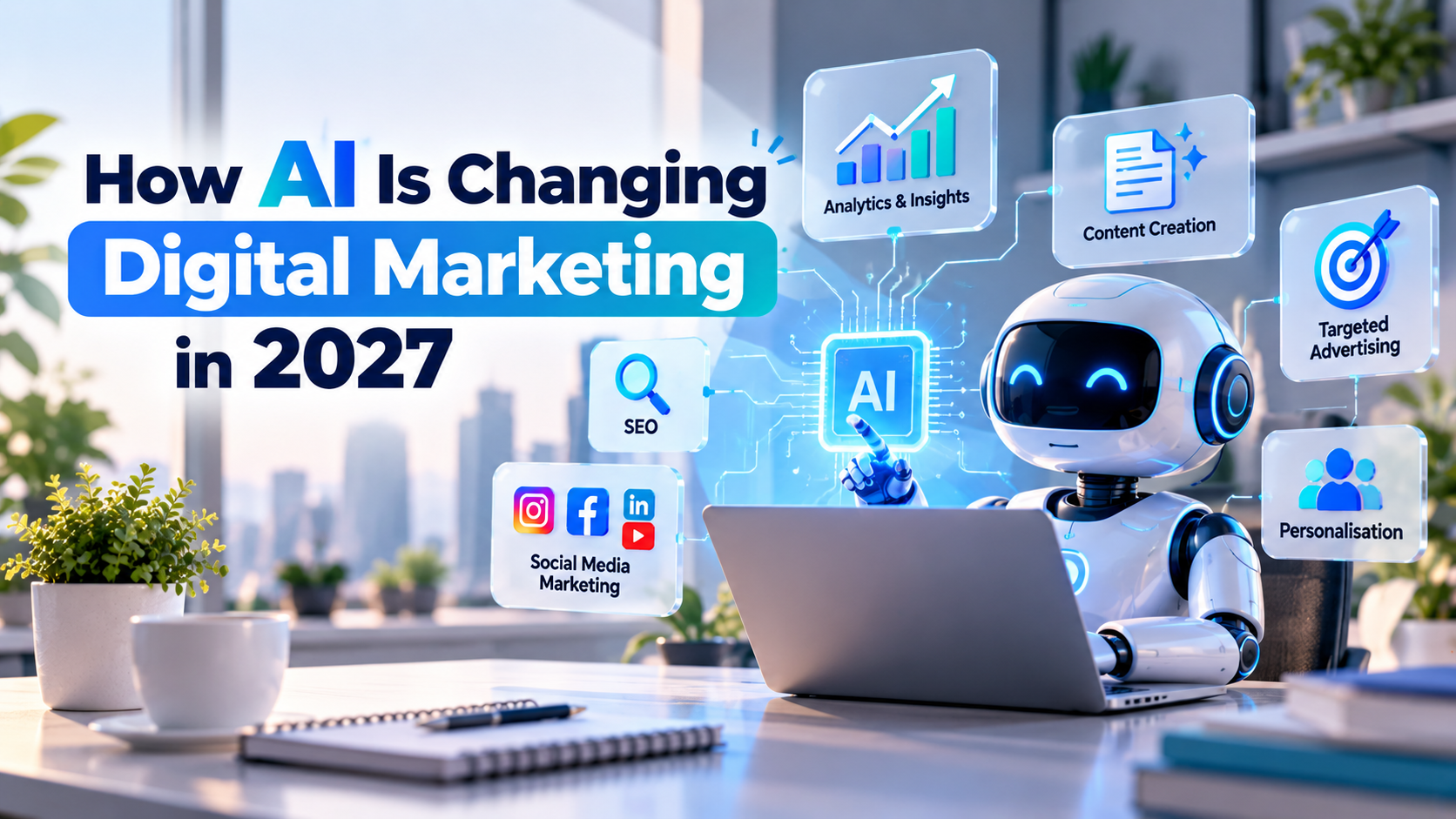
Artificial intelligence is changing how businesses plan, create, analyse, and optimise their digital marketing activities. Content creation, customer research, advertising, analytics, personalisation, and automation are all areas where AI can support marketing workflows.
As digital channels become more competitive, marketers need to understand customer behaviour, work with data, create relevant content, and make informed decisions. AI can assist with many of these activities while giving marketers more time to focus on strategy, creativity, and decision-making.
For anyone planning a career in digital marketing, understanding how AI is being used can become an important part of developing modern marketing skills. The goal is not simply to use AI tools, but to understand where they provide value and where human judgement remains necessary.
AI in Digital Marketing: The New Marketing Landscape
AI in digital marketing refers to the use of artificial intelligence technologies to support activities such as research, content creation, personalisation, advertising, customer analysis, automation, and performance measurement.
Modern AI systems can process large amounts of information, identify patterns, generate content, assist with repetitive tasks, and help marketers explore ideas and data more efficiently.
However, AI does not replace the fundamentals of marketing. Understanding the audience, defining business objectives, developing a clear strategy, and measuring meaningful outcomes remain essential.
How AI Is Changing Content Creation
Content creation is one of the most visible areas where AI is influencing digital marketing. Marketers can use AI to brainstorm topics, create outlines, generate initial drafts, develop social media ideas, rewrite copy, and adapt existing content for different platforms.
AI can make content workflows faster, particularly when marketers need multiple versions of content for different audiences and channels.
Common AI Applications in Content Marketing
- Generating topic ideas
- Creating content outlines
- Developing social media concepts
- Drafting email campaigns
- Repurposing long-form content
- Creating headline variations
- Supporting content personalisation
- Improving content workflows
A practical AI digital marketing course can help learners understand how these tools fit into broader marketing workflows rather than treating AI content generation as a standalone skill.
Human review remains important because AI-generated content needs to be checked for accuracy, relevance, originality, tone, and brand consistency.
AI and Search Engine Optimisation
SEO is also being influenced by artificial intelligence. Search engines use increasingly sophisticated systems to understand queries, content, context, and user intent. At the same time, marketers can use AI tools to support keyword research, content planning, competitor analysis, and website optimisation.
AI Applications in SEO
- Keyword research assistance
- Search intent analysis
- Content topic discovery
- Content briefs
- Internal linking suggestions
- Competitor content analysis
- Content optimisation
- SEO reporting and analysis
AI can help identify relationships between topics and potential content opportunities, but successful SEO still requires useful, original, people-focused content. Marketers need to evaluate whether the final content genuinely answers the audience's needs.
AI-Powered Personalisation
Personalisation allows businesses to provide different audiences with more relevant messages and experiences. AI can help analyse customer interactions and behavioural signals to identify patterns across audience groups.
This can support personalised email campaigns, product recommendations, advertising messages, and website experiences.
For example, an online business may analyse the products a visitor has explored and use that information to provide relevant follow-up communication.
Personalisation should be handled carefully. Businesses need appropriate data practices and should consider customer privacy when using information to create personalised marketing experiences.
AI Is Transforming Digital Advertising
Paid advertising is becoming increasingly automated. Advertising platforms can use AI to analyse signals, identify potential audiences, optimise campaigns, and assist with creative development.
How AI Can Support Paid Campaigns
- Audience analysis
- Campaign recommendations
- Ad copy variations
- Creative development
- Budget optimisation
- Performance analysis
- Conversion prediction
- Campaign experimentation
For marketers, this makes advertising strategy increasingly important. They still need to define campaign objectives, understand customers, establish appropriate budgets, review results, and make strategic decisions.
AI and Social Media Marketing
AI can support social media marketing through content planning, audience analysis, creative development, content repurposing, and performance measurement.
AI Use Cases for Social Media
- Content idea generation
- Caption drafting
- Content calendar planning
- Audience research
- Trend analysis
- Creative brainstorming
- Performance reporting
- Content repurposing
AI can reduce the time required to develop content variations, but social media still requires an understanding of context, culture, brand voice, audience expectations, and current conversations.
AI-Powered Marketing Analytics
Digital marketing generates large amounts of information through website traffic, advertising performance, conversions, engagement, customer behaviour, and campaign results.
AI can help marketers identify patterns, summarise performance information, highlight significant changes, and support the interpretation of large datasets.
This can make analytics more accessible to marketers who may not have advanced data science skills. Instead of manually reviewing every metric, marketers can use AI-assisted analysis to investigate important changes and then examine the underlying data.
Important metrics should still be understood and AI-generated interpretations should be verified before major business decisions are made.
AI and Marketing Automation
Automation has long been part of digital marketing, but AI can expand what automated workflows are capable of doing.
Traditional automation generally follows predefined rules. AI-powered workflows can add capabilities such as analysing information, categorising data, generating content, summarising customer interactions, and supporting decisions.
Examples of AI-Assisted Marketing Automation
- Email personalisation
- Lead categorisation
- Customer segmentation
- Content repurposing
- Automated reporting
- Customer support assistance
- Campaign workflow management
- Marketing task automation
These workflows can reduce repetitive work and give marketing teams more time to focus on strategy, creative development, customer relationships, and campaign optimisation.
AI Is Changing Customer Research
Understanding customers remains at the centre of effective marketing. AI can help marketers organise and analyse customer information from multiple sources and identify common themes.
AI-assisted research can be used to analyse customer feedback, reviews, survey responses, frequently asked questions, and other forms of customer communication.
This information can help marketers identify common problems, interests, concerns, and content opportunities. Important conclusions should still be checked against reliable customer and business data.
AI and Email Marketing
Email marketing can benefit from AI through content assistance, audience segmentation, personalisation, and campaign analysis.
AI can help marketers develop subject-line variations, email drafts, audience-specific messages, and content ideas. It can also assist with analysing campaign performance and identifying patterns that deserve further investigation.
Effective email marketing still depends on understanding the audience, providing useful information, maintaining a consistent brand voice, and respecting customer preferences.
AI Is Supporting Faster Marketing Experiments
Testing is an important part of digital marketing. Marketers may compare headlines, images, landing pages, advertisements, calls to action, and audience segments.
AI can help generate multiple variations for testing, reducing the amount of time required to produce each version.
However, generating more variations does not automatically improve campaign performance. Results still need to be measured and interpreted using appropriate marketing and business metrics.
Learn AI-Powered Digital Marketing Skills
As AI becomes more integrated into marketing platforms, digital marketers need a combination of traditional marketing knowledge and AI-related skills.
These skills include understanding how to select appropriate AI tools, write useful prompts, evaluate outputs, protect sensitive information, and connect AI capabilities with real marketing objectives.
Marketers do not need to learn every AI tool available. Instead, they should understand the purpose of different tools and how they can support specific marketing tasks.
Prompt Engineering as a Marketing Skill
As marketers increasingly work with generative AI systems, prompt writing can become a useful professional skill.
Effective prompts can include clear instructions, context, objectives, constraints, and relevant information. This can make it easier to generate useful content ideas, campaign concepts, research summaries, customer personas, and marketing variations.
Prompt engineering should not replace marketing knowledge. Marketers who understand audiences, positioning, copywriting, SEO, advertising, and analytics are better positioned to evaluate whether an AI output actually supports their marketing objective.
The Human Role in AI-Powered Marketing
AI can automate and accelerate many marketing tasks, but human judgement remains important.
Marketing involves creativity, communication, brand positioning, strategic thinking, ethical considerations, and understanding people. These areas require more than simply generating information.
Marketers need to review AI-generated content, check factual claims, maintain brand standards, identify inappropriate outputs, and decide whether an AI recommendation makes sense for the business.
The practical role of AI is therefore to support marketing teams rather than remove the need for marketing strategy and decision-making.
Skills Digital Marketers Should Build for 2027
As AI becomes part of more marketing workflows, digital marketers can benefit from developing a combination of technical, analytical, creative, and strategic skills.
- Digital marketing fundamentals
- SEO
- Content marketing
- Social media marketing
- Paid advertising
- Marketing analytics
- AI tool usage
- Prompt engineering
- Marketing automation
- Data interpretation
- Copywriting
- Creative thinking
- Strategic decision-making
Building these skills can help marketers use AI as part of a broader marketing strategy rather than treating it as an isolated technology.
How Beginners Can Start Learning AI in Digital Marketing
Beginners do not need to learn every AI platform at once. A structured approach can make the learning process easier.
- Learn digital marketing fundamentals.
- Understand SEO, content, social media, and paid advertising.
- Learn how AI is used in each marketing channel.
- Practise writing effective prompts.
- Experiment with AI-assisted content creation.
- Learn AI-supported analytics and research.
- Build practical marketing projects.
- Evaluate AI-generated outputs critically.
- Create a portfolio showing your marketing and AI skills.
A structured AI marketing learning path can help learners connect AI tools with practical marketing activities rather than learning tools without understanding their purpose.
Why Practical Experience Matters
Learning about AI is only the first step. Practical projects can help learners understand how AI fits into real marketing workflows.
For example, learners can create an AI-assisted content strategy, develop a sample social media campaign, prepare an SEO content plan, analyse a sample advertising dataset, or design an automated email workflow.
For each project, it can be useful to document the objective, tools used, workflow, human review process, and outcome. This helps demonstrate an understanding of both marketing principles and AI-assisted execution.
Practical projects can also help learners develop a future-ready digital marketing skill set that combines established marketing knowledge with modern AI workflows.
Conclusion
AI is changing digital marketing by making many marketing activities faster, more data-driven, and easier to scale. Content creation, SEO, advertising, social media, analytics, personalisation, customer research, and automation are all areas where AI can support marketing teams.
At the same time, AI does not remove the need for marketing knowledge. Marketers still need to understand customers, develop strategies, evaluate information, create meaningful communication, and make decisions based on business objectives.
For 2027 and beyond, learning AI alongside core digital marketing skills can help marketers adapt to changing tools and workflows. The most practical approach is to combine AI capabilities with human creativity, critical thinking, strategic understanding, and practical experience.
Contact Upskill Now
Upskill Now
A-3, Third Floor, Rajouri Garden, New Delhi – 110027
Phone: 9999848160 | 9711448765
Email: connect@upskillnow.in