
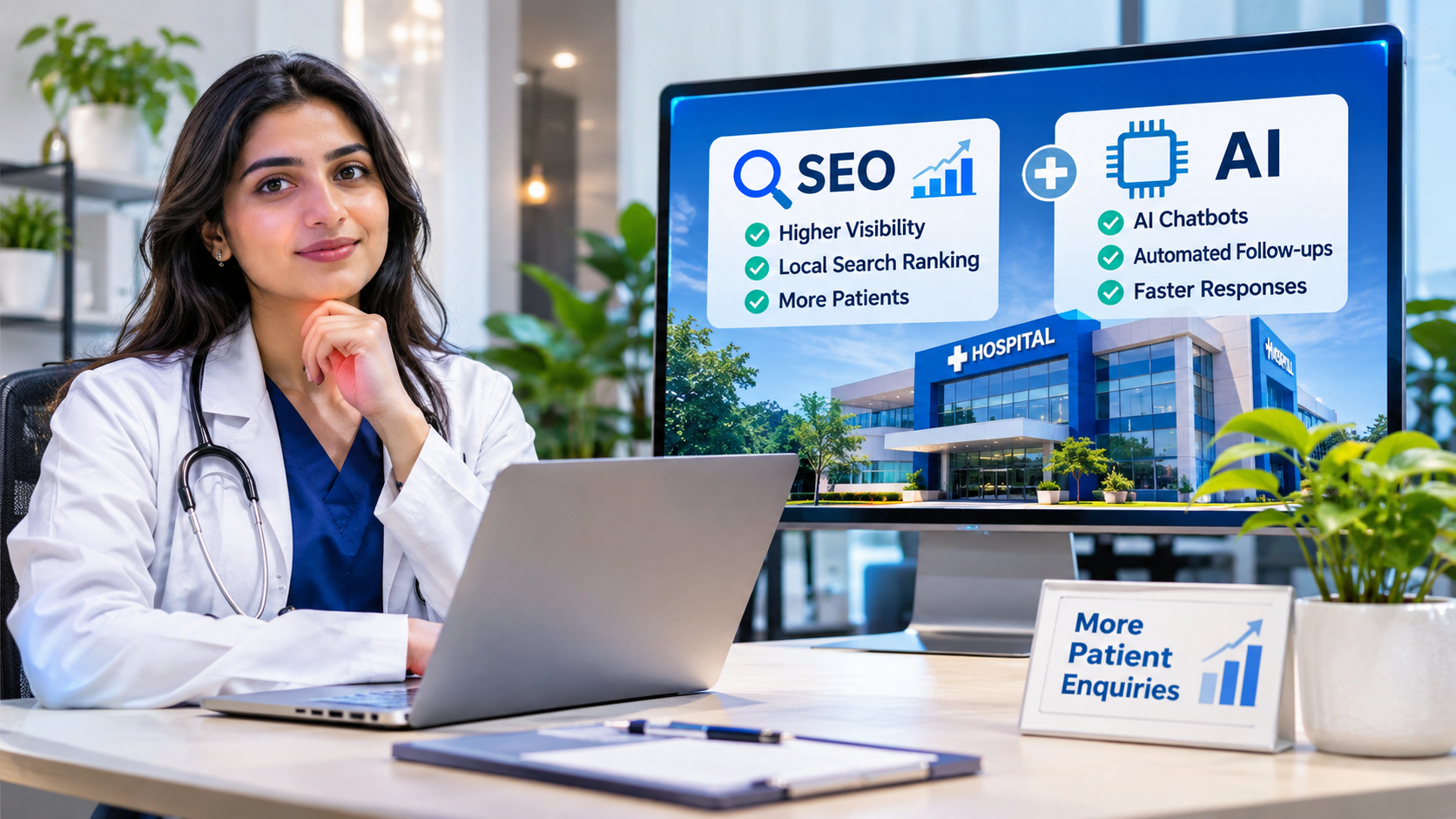
The healthcare industry is becoming increasingly competitive, and patients are using the internet to find hospitals, clinics, doctors and healthcare services. Before booking an appointment, people often search online to compare services, check clinic locations, explore treatment information and understand available healthcare facilities.
Search Engine Optimization (SEO) and Artificial Intelligence (AI) can help healthcare businesses improve their online visibility, attract relevant website visitors and manage patient enquiries more efficiently.
By combining local SEO, helpful healthcare content, website optimization and AI-powered automation, healthcare businesses can create a structured digital marketing strategy.
In this blog, we will explore how healthcare businesses can use SEO and AI to generate more patient enquiries and improve their online marketing activities.
1. Use SEO to Improve Healthcare Website Visibility
Search Engine Optimization (SEO) helps healthcare websites appear in search engine results when people search for relevant medical services, clinics or healthcare information.
For example, someone searching for "dentist near me" or "skin clinic in Delhi" may be looking for a nearby healthcare provider.
If your website is properly optimized, it has an opportunity to appear in relevant search results and attract potential patients.
Conduct Healthcare Keyword Research
Keyword research helps healthcare businesses understand what people search for when looking for medical services.
Start by identifying keywords related to your services, treatments and locations.
Examples include:
-
Dental clinic in Delhi.
-
Skin specialist near me.
-
Diagnostic centre in Noida.
-
Best physiotherapy clinic in Gurgaon.
-
General physician in Rajouri Garden.
Include relevant keywords naturally in website headings, service descriptions, page titles and blog content.
Focus on search intent rather than simply adding popular keywords. Someone searching for a clinic's location may have different requirements from someone researching a particular medical service.
Optimize Healthcare Service Pages
Every major healthcare service should have a dedicated webpage explaining the services provided.
For example, a dental clinic can create separate pages for dental consultations, teeth cleaning, orthodontic services and other treatments it actually offers.
Each service page should include:
-
A clear service heading.
-
An informative service description.
-
Available consultation details.
-
Clinic address and contact information.
-
Appointment booking options.
-
Relevant information about the healthcare professionals.
-
Answers to common patient questions.
Make sure all medical information is reviewed by qualified healthcare professionals before publication.
Publish Helpful Healthcare Blogs
Blogging is an effective way to attract people searching for healthcare information.
Healthcare businesses can publish educational articles that answer common patient questions.
Examples include:
-
How to Choose the Right Dental Clinic.
-
What to Know Before Booking a Health Checkup.
-
Common Questions to Ask During a Doctor Consultation.
-
How to Prepare for a Physiotherapy Appointment.
-
Important Factors to Consider When Choosing a Diagnostic Centre.
Focus on accurate, understandable and informative content.
Avoid making guaranteed treatment claims or presenting general information as personalized medical advice.
2. Use Local SEO to Attract Nearby Patients
Local SEO is particularly important for hospitals, clinics and diagnostic centres because many patients prefer healthcare providers located near their homes or workplaces.
A well-planned local SEO strategy can help healthcare businesses become more visible to people searching for nearby medical services.
Optimize Your Google Business Profile
A properly maintained Google Business Profile helps patients find important information about your healthcare business.
Healthcare businesses should:
-
Use the correct business name.
-
Add an accurate clinic or hospital address.
-
Select relevant business categories.
-
Mention available healthcare services.
-
Add updated contact information.
-
Include working hours.
-
Upload genuine photographs.
-
Respond professionally to patient reviews.
Keep all business information accurate and consistent across your online presence.
Create Location-Specific Website Pages
If a healthcare business operates in multiple locations, it can create separate webpages for each branch.
For example, a healthcare provider with clinics in Delhi and Noida can create individual location pages containing:
-
Branch address.
-
Available services.
-
Consultation information.
-
Contact details.
-
Appointment options.
-
Directions and accessibility information.
This helps search engines understand where the healthcare business operates and helps potential patients find relevant location information.
Encourage Genuine Patient Reviews
Patient reviews can help people understand other patients' experiences with a healthcare provider.
Healthcare businesses can encourage patients to share honest feedback without offering incentives or pressuring them.
Respond to reviews professionally and avoid revealing private medical information when replying publicly.
3. Use AI to Improve Healthcare Content Marketing
Artificial Intelligence can help healthcare marketing teams create, organize and improve content more efficiently.
Healthcare businesses regularly need website content, educational blogs, service descriptions and social media posts.
AI tools can support these activities while allowing healthcare professionals to review and approve the final information.
AI for Healthcare Blog Writing
AI can assist with generating blog ideas, preparing outlines and creating initial content drafts.
For example, a healthcare marketing team can use AI to develop a blog outline about preparing for a routine health checkup.
The team can then review the information, add relevant details and ensure medical accuracy before publishing.
AI can help with:
-
Healthcare blog topic research.
-
SEO-friendly headings.
-
Content outlines.
-
Frequently asked questions.
-
Website content drafts.
-
Content proofreading.
Medical accuracy and professional review should always remain priorities.
AI for Website Content Optimization
AI can help identify opportunities to improve existing website content.
Healthcare businesses can use AI-assisted tools to:
-
Improve page readability.
-
Identify missing information.
-
Organize service descriptions.
-
Suggest relevant headings.
-
Generate title and meta description drafts.
-
Identify content duplication.
-
Create content improvement suggestions.
For example, if a clinic has a service page with very limited information, AI can help prepare a clearer structure covering consultation details, available services and appointment procedures.
The final content should be checked by the relevant healthcare professionals.
4. Use AI Chatbots to Manage Patient Enquiries
One of the practical applications of AI in healthcare marketing is automated website communication.
Patients visiting a healthcare website may have basic questions about clinic timings, locations, appointment procedures and available services.
An AI chatbot can help answer approved general questions and guide visitors towards the appropriate enquiry channel.
How Healthcare Chatbots Work
A chatbot can ask visitors simple questions such as:
-
Which healthcare service are you looking for?
-
Which clinic location would you prefer?
-
Would you like information about appointment availability?
-
Do you need assistance contacting the clinic?
Based on the responses, the chatbot can guide visitors to the relevant service page or appointment enquiry form.
Benefits of AI Chatbots
AI chatbots can help healthcare businesses:
-
Handle common enquiries.
-
Provide basic clinic information.
-
Guide visitors to appointment forms.
-
Direct enquiries to the appropriate department.
-
Reduce repetitive administrative communication.
-
Provide an organized website experience.
However, chatbots should not diagnose medical conditions, recommend treatments or replace qualified healthcare professionals.
They should also provide a clear option for patients to contact a human representative.
5. Automate Patient Enquiry Follow-Ups
Managing incoming enquiries is an important part of healthcare marketing.
When patients submit appointment requests through a website, businesses need an organized process to respond and manage those enquiries.
AI automation and workflow systems can help simplify these activities.
Automated Appointment Confirmations
When a patient submits an appointment request, an automated system can send a confirmation message.
The message can include:
-
Enquiry acknowledgement.
-
Requested appointment details.
-
Clinic contact information.
-
Instructions for contacting the reception team.
The system should clearly distinguish between an appointment request and a confirmed appointment.
Automated Follow-Up Reminders
Healthcare businesses can use approved communication workflows to send appointment reminders and administrative updates.
For example, when an appointment is confirmed, the system can send a reminder before the scheduled visit.
This helps patients stay informed and supports the clinic's appointment management process.
Organize Enquiries Using CRM Systems
A Customer Relationship Management (CRM) system helps healthcare businesses manage communication and enquiry records.
With appropriate access controls, businesses can use CRM workflows to:
-
Record incoming enquiries.
-
Assign enquiries to staff members.
-
Track enquiry status.
-
Manage appointment requests.
-
Monitor response times.
-
Organize administrative follow-ups.
Healthcare businesses must protect patient information and follow applicable privacy and data protection requirements. Sensitive medical information should not be entered into general-purpose AI tools without appropriate authorization and safeguards.
6. Improve Healthcare Website Conversion Rates
Generating website traffic is only one part of digital marketing. Healthcare businesses also need to make it easy for visitors to contact the clinic or request an appointment.
A user-friendly website can help turn relevant visitors into patient enquiries.
Create Clear Appointment Booking Options
Make appointment options easy to find throughout the website.
Use clear buttons such as:
-
Book an Appointment.
-
Request a Consultation.
-
Contact the Clinic.
-
Enquire About Services.
Avoid complicated forms that ask visitors for unnecessary information.
Optimize Your Website for Mobile Devices
Many people search for nearby healthcare services using smartphones.
Ensure that your website:
-
Loads efficiently.
-
Displays readable text.
-
Has simple navigation.
-
Includes clickable contact information.
-
Provides mobile-friendly enquiry forms.
-
Makes appointment options easy to access.
Build Trust Through Professional Website Content
Healthcare websites should provide accurate and transparent information.
Include relevant details about:
-
Healthcare professionals and their qualifications.
-
Available services.
-
Clinic locations.
-
Consultation procedures.
-
Appointment information.
-
Contact channels.
Avoid misleading claims, unsupported success rates and guarantees about medical outcomes.
7. Measure SEO and AI Marketing Performance
Healthcare businesses should regularly evaluate their digital marketing activities to understand which strategies are generating relevant enquiries.
Tracking performance helps marketing teams identify areas that need improvement.
Important SEO Metrics
Monitor:
-
Organic website traffic.
-
Search engine visibility.
-
Keyword performance.
-
Local search visibility.
-
Service page performance.
-
Website enquiry submissions.
Important AI Automation Metrics
Evaluate:
-
Number of enquiries handled.
-
Chatbot interaction rates.
-
Enquiry response time.
-
Appointment request completion.
-
Follow-up completion.
-
Workflow accuracy.
Improve Marketing Based on Results
For example, if a clinic receives website traffic through its dental service page but gets very few appointment enquiries, the marketing team can review the page's content, contact options and booking process.
Similarly, if chatbot interactions are high but visitors are not reaching the appointment form, the chatbot's questions and guidance may need improvement.
Use actual performance data to make decisions rather than relying on assumptions.
8. Combine SEO and AI for Better Patient Enquiry Management
SEO and AI work best when they support different stages of the patient enquiry journey.
Healthcare businesses can combine these strategies through a structured process.
Step 1: Attract Relevant Visitors Through SEO
Optimize healthcare service pages and publish useful content to improve search visibility.
Step 2: Improve Local Search Presence
Maintain accurate business information and create relevant location-specific pages.
Step 3: Guide Visitors Using AI Chatbots
Use chatbots to answer approved general questions and direct visitors towards the correct enquiry channel.
Step 4: Collect Appointment Requests
Provide simple enquiry forms and clear appointment booking options.
Step 5: Automate Administrative Follow-Ups
Use appropriate workflows to send enquiry confirmations, reminders and administrative updates.
Step 6: Monitor Performance
Review website traffic, enquiry submissions, response times and appointment requests to improve the marketing process.
This approach helps healthcare businesses create a more organized online presence while making it easier for potential patients to connect with their services.
Conclusion
SEO and Artificial Intelligence are valuable tools for healthcare businesses that want to improve online visibility and generate more patient enquiries.
SEO helps hospitals, clinics and diagnostic centres reach people searching for relevant healthcare services. Local SEO improves visibility in specific locations, while helpful website content builds awareness and provides useful information.
AI supports healthcare marketing through content assistance, chatbots, enquiry management and automated administrative follow-ups.
When these strategies are combined with a professional website, accurate information and responsible patient communication, healthcare businesses can create a more effective digital marketing process.
At Upskill Now, learners can explore practical digital marketing and AI-related learning opportunities, including SEO, content marketing, advertising and marketing automation.
The AI Digital Marketing Master Program covers relevant skills such as SEO, Google Ads, AI tools and automation workflows. These skills can help learners understand how digital marketing strategies are planned and implemented across different industries, including healthcare.
If you want to develop practical knowledge of modern SEO and AI-powered marketing, explore the courses available at Upskill Now and take the next step towards building your digital marketing skills.
SEO Keywords
-
Healthcare SEO
-
AI for Healthcare Marketing
-
Patient Enquiry Generation
-
Healthcare Digital Marketing
-
AI Automation for Healthcare
Frequently Asked Questions (FAQs)
1. How can SEO help healthcare businesses generate more patient enquiries?
SEO helps healthcare websites appear in relevant search results when people look for clinics, hospitals, doctors and medical services. Optimized service pages, local SEO and informative healthcare blogs can attract relevant visitors and encourage them to submit appointment enquiries.
2. What is the role of AI in healthcare digital marketing?
AI can support healthcare marketing through content creation, website optimization, chatbot communication, enquiry management and administrative automation. It helps marketing teams manage repetitive tasks while allowing healthcare professionals to review medical information.
3. How can local SEO help hospitals and clinics attract nearby patients?
Local SEO improves the online visibility of healthcare businesses in specific geographical areas. Accurate business profiles, location-specific website pages, updated contact details and genuine patient reviews can help people discover nearby healthcare services.
4. Can AI chatbots help healthcare businesses manage patient enquiries?
Yes. AI chatbots can answer approved general questions, share clinic information, guide visitors towards appointment forms and direct enquiries to the appropriate department. They should not provide medical diagnoses or replace professional medical advice.
5. How can healthcare businesses combine SEO and AI to generate more enquiries?
Healthcare businesses can use SEO to attract relevant website visitors and AI chatbots to guide them towards enquiry forms. Automated workflows can then support appointment confirmations, reminders and administrative follow-ups. Regular performance monitoring helps improve the overall process.
Contact Upskill Now
-
Address: A-3, Third Floor, Rajouri Garden, New Delhi – 110027, India
-
Contact Number: +91 99998 48160
-
Alternate Number: +91 97114 48765