
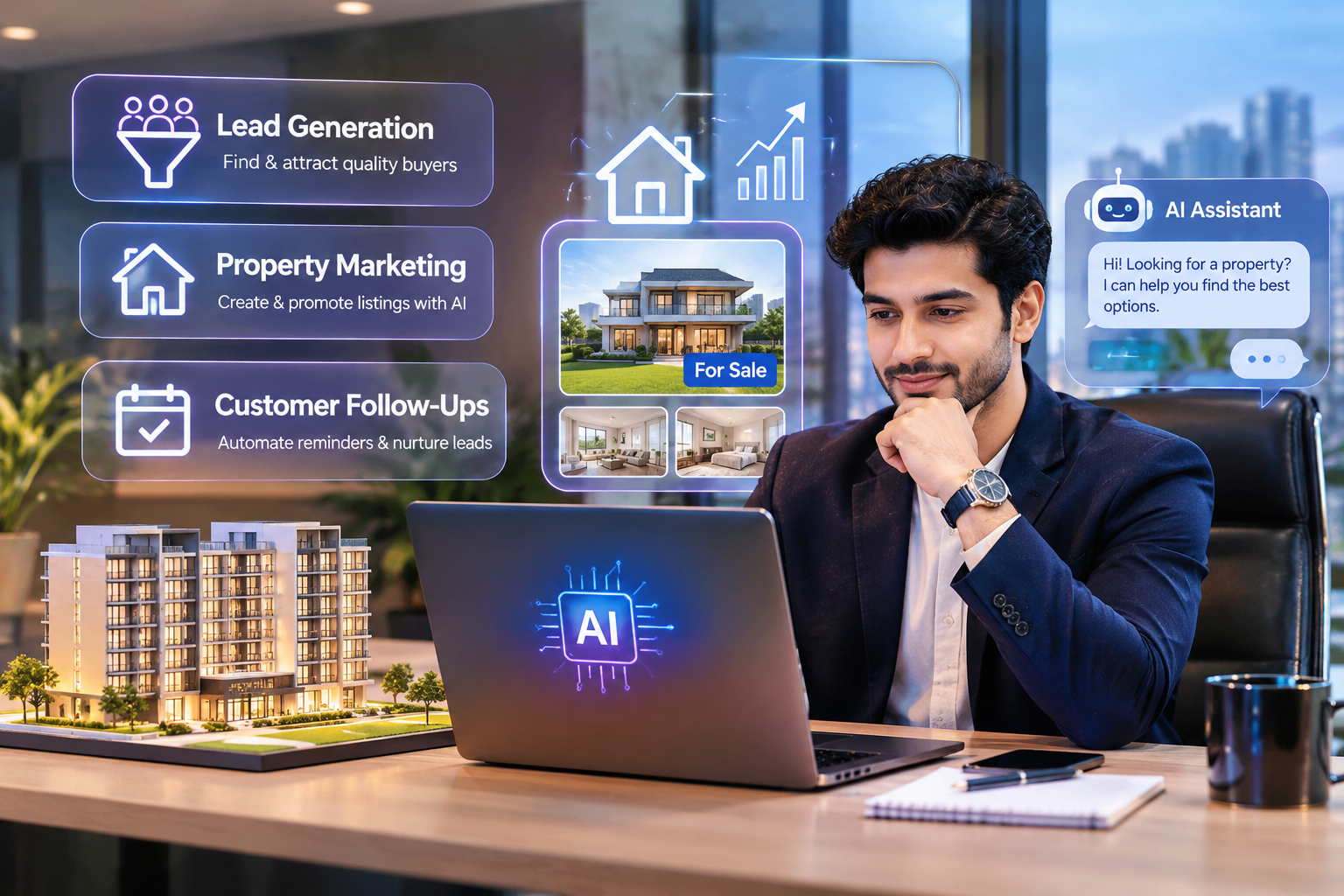
Managing these customer enquiries, promoting properties, and following up with potential buyers can be challenging. Real estate companies often handle multiple property listings, customer enquiries, site visit requests, and sales conversations simultaneously.
Artificial Intelligence (AI) is helping real estate businesses manage these activities more efficiently. AI-powered tools can support lead generation, property marketing, customer segmentation, automated communication, and follow-up management.
With the right AI strategy, real estate companies can understand customer requirements, create targeted property advertisements, respond to enquiries faster, and organise their sales processes.
In this blog, we will explore how real estate companies use AI for lead generation, property marketing, and customer follow-ups, along with practical examples and implementation strategies.
1. What Is AI in Real Estate Marketing?
AI in real estate marketing refers to using artificial intelligence technologies to improve property promotion, customer communication, lead management, and marketing activities.
Instead of handling every marketing task manually, real estate companies can use AI to analyse customer information, generate marketing content, automate repetitive activities, and identify potential buyers.
For example, when someone visits a property website and submits an enquiry, an AI-powered system can help organise the lead, identify the customer's property preferences, and trigger an appropriate follow-up message.
Why Are Real Estate Companies Adopting AI?
Real estate businesses can use AI to:
-
Identify potential property buyers and investors.
-
Generate property marketing content.
-
Create targeted advertising campaigns.
-
Respond to customer enquiries quickly.
-
Automate routine follow-up messages.
-
Organise leads based on customer interests.
-
Analyse marketing campaign performance.
-
Improve communication throughout the buying journey.
AI does not replace the importance of real estate professionals. Instead, it supports their work by reducing repetitive tasks and helping them focus on customer relationships and property sales.
2. How Real Estate Companies Use AI for Lead Generation
Lead generation is one of the most important activities for real estate businesses. Companies need to attract people who are interested in purchasing, renting, or investing in properties.
AI can help identify potential customers, organise enquiries, and improve lead management.
2.1 AI-Powered Website Lead Generation
Real estate companies can integrate AI-powered chatbots into their websites to interact with visitors and collect property enquiries.
A chatbot can ask visitors questions such as:
-
Are you looking to buy or rent a property?
-
Which location do you prefer?
-
What is your approximate budget?
-
How many bedrooms do you need?
-
When are you planning to purchase?
Based on the responses, the system can organise customer information and direct the enquiry to the appropriate sales representative.
Practical example:
A real estate company receives an enquiry from someone searching for a two-bedroom apartment in Delhi.
An AI chatbot can collect the customer's location preference, budget, and contact information. The sales team can then use these details to recommend relevant property options.
2.2 AI-Based Lead Scoring
Not every property enquiry has the same level of buying interest.
AI-based lead scoring helps real estate companies prioritise enquiries based on available customer information and engagement signals.
For example:
-
A customer requesting an immediate site visit may indicate strong purchase interest.
-
A customer repeatedly viewing the same property may require additional information.
-
A customer downloading a property brochure may be interested but still researching.
AI systems can help assign lead priority based on predefined criteria and available data.
This allows sales teams to focus their attention on enquiries that require immediate communication.
2.3 Customer Segmentation Using AI
AI can help divide property enquiries into different customer groups.
Common real estate customer segments include:
-
First-time homebuyers.
-
Property investors.
-
Luxury property buyers.
-
Rental property seekers.
-
Commercial property buyers.
-
Customers looking for residential apartments.
For example, a company promoting commercial office spaces can create a separate marketing campaign for business owners and investors rather than sending the same advertisements to every customer.
Better segmentation helps businesses create more relevant communication.
2.4 AI for Lead Data Analysis
Real estate companies receive leads from multiple sources, including websites, social media, search campaigns, and property enquiry forms.
AI-powered analytics can help identify which channels generate enquiries, which campaigns attract interested buyers, and where potential customers stop engaging.
This information helps marketing teams make better decisions about their advertising budgets and lead generation strategies.
3. How Real Estate Companies Use AI for Property Marketing
Property marketing requires attractive visuals, informative descriptions, targeted advertisements, and consistent online promotion.
AI can help businesses create and manage these marketing activities.
3.1 AI-Generated Property Descriptions
Writing descriptions for multiple property listings can take considerable time.
AI writing tools can help create property descriptions using information such as:
-
Property location.
-
Property type.
-
Number of bedrooms.
-
Available facilities.
-
Carpet area or built-up area.
-
Nearby amenities.
-
Verified property features.
Example:
A real estate company provides details about a three-bedroom apartment, including its location, floor area, amenities, and available facilities.
AI can convert these details into a clear and attractive property description for the company's website or marketing materials.
However, marketers must verify all property information before publishing it. AI should never invent amenities, property specifications, prices, or location advantages.
3.2 AI for Property Images and Virtual Staging
Property images influence how potential buyers perceive a listing.
AI-powered image editing and virtual staging can help real estate companies present properties more effectively.
Possible applications include:
-
Improving image brightness and clarity.
-
Removing minor visual distractions.
-
Creating virtual furniture arrangements.
-
Presenting alternative interior designs.
-
Preparing property marketing creatives.
For example, an unfurnished apartment can be presented with digitally added furniture to help potential buyers understand how the available space could be used.
Virtual staging should be clearly identified, and the original property condition should not be misrepresented.
3.3 AI-Powered Social Media Marketing
Social media helps real estate companies reach potential buyers, promote property listings, and build brand awareness.
AI can support social media marketing through:
-
Property post ideas.
-
Captions and descriptions.
-
Short-form video scripts.
-
Promotional content calendars.
-
Audience-specific messaging.
-
Advertisement creative variations.
Practical example:
A real estate company launching a residential project can use AI to develop separate content ideas for families, first-time homebuyers, and property investors.
Each campaign can focus on relevant property features and customer requirements.
3.4 AI for Real Estate Advertising Campaigns
AI can help marketers prepare and improve property advertising campaigns.
It can support:
-
Advertising copywriting.
-
Audience research.
-
Campaign creative development.
-
Customer segmentation.
-
Lead form optimisation.
-
Performance analysis.
For example, a real estate business promoting residential apartments can test different advertisement messages focused on location, apartment features, or lifestyle benefits.
The marketing team can analyse campaign results and identify which messaging attracts more relevant enquiries.
3.5 AI for Property Video Marketing
Property videos allow potential buyers to understand the layout, interiors, and features of a property.
AI-assisted video tools can help create:
-
Property walkthrough videos.
-
Promotional video scripts.
-
Short social media videos.
-
Video captions and subtitles.
-
Edited property presentations.
-
Virtual property presentations.
These videos can be used on property websites and social media channels to provide customers with more information before arranging a physical site visit.
4. How AI Automates Customer Follow-Ups in Real Estate
Following up with potential buyers is essential because property purchases often involve multiple conversations, comparisons, and site visits.
AI-powered automation can help real estate companies maintain communication with customers throughout the sales journey.
4.1 Automated WhatsApp and Email Follow-Ups
AI-supported communication systems can help businesses send personalised messages based on customer enquiries and preferences.
For example, when a customer requests information about a residential project, the company can send:
-
An enquiry confirmation.
-
A property brochure.
-
Relevant property details.
-
Available site visit information.
-
A follow-up message after the enquiry.
Communication should be based on customer consent and applicable messaging requirements.
4.2 AI Chatbots for Customer Support
AI chatbots can answer common property-related questions at any time.
Customers may ask about:
-
Property availability.
-
Apartment configurations.
-
Property amenities.
-
Location details.
-
Site visit arrangements.
-
General project information.
The chatbot can provide approved information and transfer complex enquiries to a human representative.
This helps customers receive initial assistance without waiting for a sales executive to become available.
4.3 Automated Site Visit Scheduling
Scheduling property visits often requires communication between customers and sales teams.
AI-assisted systems can help organise appointment requests, check available time slots, and send confirmations or reminders.
Example:
A customer enquires about visiting an apartment on Saturday.
The system can collect the preferred time, check the available appointment slots, and help the sales representative confirm the visit.
This reduces repetitive coordination and makes the appointment process more organised.
4.4 Personalised Property Recommendations
AI can analyse customer preferences to help recommend relevant property listings.
For example, a customer searching for a two-bedroom apartment within a particular budget and location may receive recommendations matching those requirements.
Recommendations should be based on accurate, current listing information and transparent selection criteria.
4.5 AI-Based Follow-Up Reminders
Sales representatives sometimes manage hundreds of customer enquiries.
AI-supported CRM systems can help organise follow-up tasks and reminders based on enquiry status.
For example:
-
New enquiry: Contact the customer.
-
Brochure shared: Check whether additional information is needed.
-
Site visit completed: Request feedback.
-
Interested buyer: Arrange the next discussion.
-
Purchase decision pending: Schedule an appropriate follow-up.
This creates a more organised customer communication process.
5. Practical AI Marketing Workflow for Real Estate Companies
Real estate companies can combine AI lead generation, property marketing, and customer follow-ups into one structured workflow.
Step 1: Attract Potential Property Buyers
Use property websites, search engine marketing, social media content, and digital advertisements to attract relevant customers.
Step 2: Collect Customer Enquiries
Use website enquiry forms, approved chatbots, and advertising lead forms to collect customer information.
Step 3: Organise and Qualify Leads
Use a CRM system and AI-assisted analysis to organise customer requirements, budgets, property preferences, and enquiry status.
Step 4: Create Personalised Property Marketing
Prepare property descriptions, social media content, advertising creatives, and property videos based on the target audience.
Step 5: Automate Customer Communication
Send relevant enquiry confirmations, property information, appointment reminders, and follow-up messages.
Step 6: Analyse Results
Review lead quality, enquiry sources, site visits, customer engagement, and sales outcomes.
Use the results to improve future campaigns and communication.
6. Important AI Marketing Metrics for Real Estate Companies
To understand whether AI-supported marketing activities are working, real estate companies should monitor relevant performance indicators.
| Metric | What It Measures |
|---|---|
| Cost Per Lead (CPL) | Cost of generating each enquiry |
| Lead Conversion Rate | Percentage of leads progressing to the desired action |
| Website Conversion Rate | Percentage of visitors submitting enquiries |
| Site Visit Rate | Percentage of leads booking or completing site visits |
| Follow-Up Response Rate | Customer responses to follow-up communication |
| Customer Acquisition Cost | Marketing and sales cost of acquiring a customer |
| Return on Ad Spend (ROAS) | Revenue attributed to advertising compared with advertising spend |
Companies should evaluate these metrics together rather than depending on the number of enquiries alone.
For example, an advertising campaign may generate many enquiries but few actual site visits. In that situation, the company should review its audience targeting, property information, and lead qualification process.
7. Best Practices for Implementing AI in Real Estate Marketing
Real estate companies should follow a structured approach when introducing AI into their marketing operations.
7.1 Start with Specific Business Goals
Identify the main problem you want to solve.
For example, a company may want to improve enquiry management, reduce manual follow-ups, or create property marketing content more efficiently.
7.2 Use Accurate Property Information
AI-generated marketing content must be based on verified property details.
Always review prices, dimensions, amenities, availability, location information, and project claims before publishing.
7.3 Protect Customer Information
Real estate businesses should handle customer contact details, budgets, and property preferences responsibly.
Use appropriate access controls, obtain required permissions, and follow applicable data protection requirements.
7.4 Combine Automation with Human Communication
AI can manage routine enquiries and reminders, but property purchases often require personal guidance.
Sales professionals should remain involved in important conversations, negotiations, site visits, and purchase decisions.
7.5 Review AI Performance Regularly
Monitor the quality of generated content, lead qualification, customer responses, and follow-up accuracy.
Update workflows whenever customer requirements or business objectives change.
8. Developing AI and Digital Marketing Skills for Real Estate Businesses
Modern real estate marketing requires knowledge of digital advertising, lead generation, content creation, analytics, and marketing automation.
Professionals who understand these areas can use AI more effectively to support property promotion and customer communication.
Upskill Now offers learning opportunities in artificial intelligence and digital marketing that can help learners understand practical applications of modern marketing technologies.
The [AI Master Program] (https://www.upskillnow.in/) introduces learners to Generative AI, prompt engineering, AI agents, and automation. These skills can support content planning and marketing workflows.
Learners can also explore the Digital Marketing + AI Program to understand SEO, paid advertising, lead generation, campaign management, and marketing automation.
To discover additional learning opportunities, visit the Upskill Now courses page or learn more about the Upskill Now learning institute.
Businesses and professionals interested in developing these skills can contact Upskill Now for course information and guidance.
Conclusion
AI is creating new opportunities for real estate companies to improve lead generation, property marketing, and customer follow-ups.
From AI-powered chatbots and lead scoring to property descriptions, virtual staging, advertising campaigns, and automated reminders, these technologies can make marketing operations more organised and efficient.
However, successful AI adoption requires more than automation. Real estate companies must use accurate property information, protect customer data, understand buyer requirements, and maintain meaningful human communication.
By combining AI technology with practical digital marketing strategies, real estate businesses can build better customer experiences and improve their approach to property marketing.
Frequently Asked Questions (FAQs)
1. How do real estate companies use AI for lead generation?
Real estate companies use AI-powered chatbots, lead scoring, customer segmentation, and data analysis to collect enquiries, understand buyer preferences, and prioritise potential customers.
2. How does AI help in real estate property marketing?
AI helps create property descriptions, social media content, advertising creatives, promotional videos, and virtual staging visuals. It can also support audience research and advertising campaign optimisation.
3. Can AI automate customer follow-ups in real estate?
Yes. AI-supported systems can help automate enquiry confirmations, email communication, appointment reminders, property information sharing, and follow-up scheduling.
4. How can AI chatbots help real estate businesses?
AI chatbots can answer common property questions, collect customer requirements, provide approved listing information, and direct enquiries to the appropriate sales representative.
5. What are the benefits of AI marketing automation for real estate companies?
AI marketing automation can reduce repetitive work, organise customer enquiries, support personalised communication, improve follow-up management, and help businesses analyse marketing performance.
Contact Upskill Now
-
Address: A-3, Third Floor, Rajouri Garden, New Delhi – 110027, India
-
Contact Number: +91 99998 48160
-
Alternate Number: +91 97114 48765