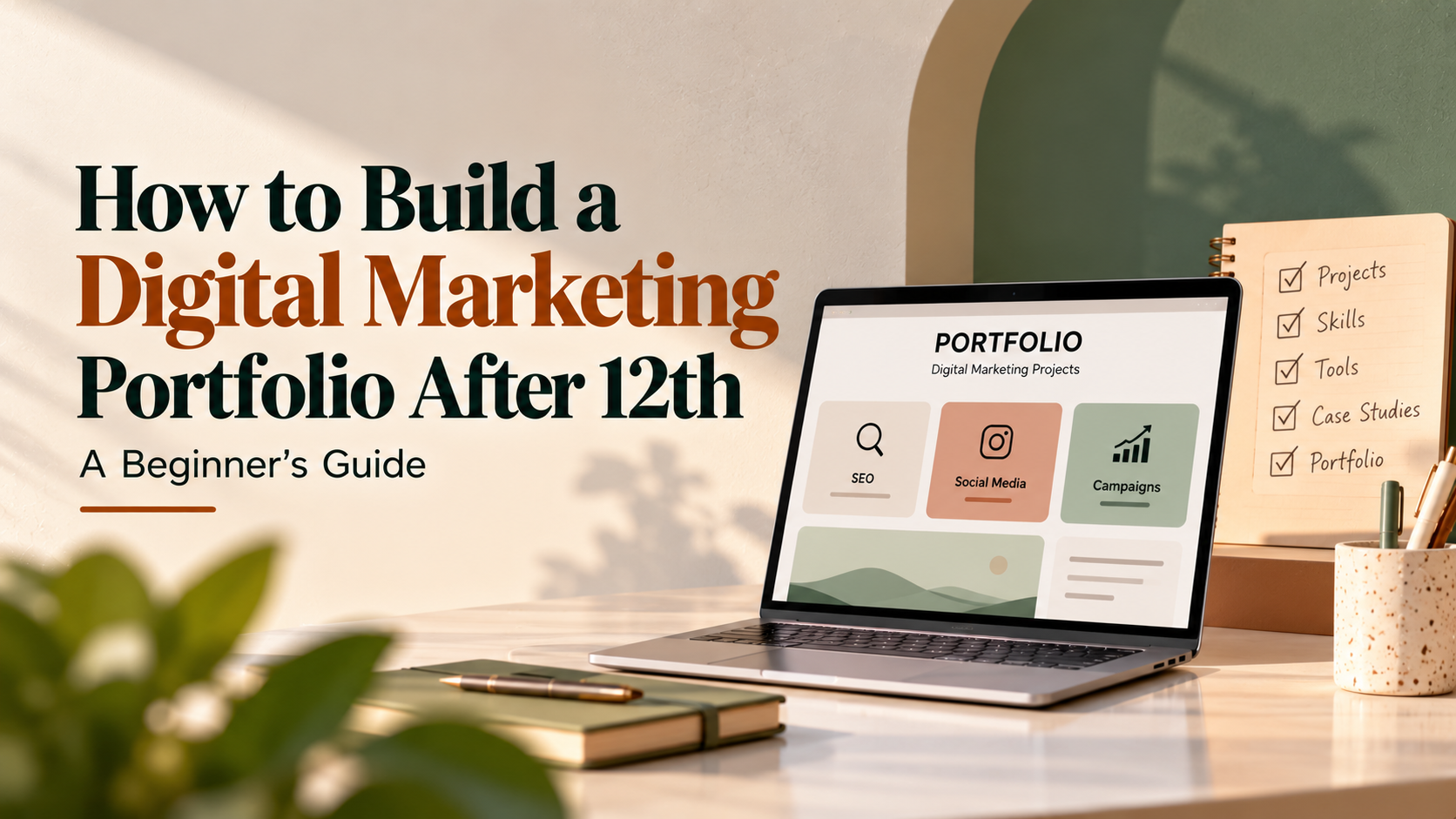
How to Build a Digital Marketing Portfolio After 12th: Beginner's Guide
One of the biggest challenges for students trying to enter digital marketing after 12th is the experience gap. Job descriptions may ask for practical knowledge, while students are often applying for their first internship or entry-level role.
A digital marketing portfolio can help solve part of this problem. It gives students an opportunity to demonstrate their skills through actual work samples rather than relying only on academic qualifications or course certificates.
You do not need years of employment history to create a digital marketing portfolio. Students can build relevant projects independently, document their process, explain their decisions and show what they learned.
The objective is not to make the portfolio look as if you have worked for companies when you have not. A strong student portfolio should clearly distinguish personal projects, academic work, simulated campaigns, internships and actual client work.
Start by creating practical projects in SEO, keyword research, social media, content marketing, paid advertising, email marketing and analytics. Document the objective, research, process, tools used and outcomes of each project. Present your work through a simple website, presentation or shareable document.
Students who need structured guidance can explore the practical digital marketing programme at Upskill Now. Its project-based learning approach can help learners identify the skills to practise and the type of work they can include in a portfolio. Explore the dedicated Upskill Now training section below.
1. What Is a Digital Marketing Portfolio?
A digital marketing portfolio is a collection of work that demonstrates your marketing skills, practical knowledge and thought process.
It can contain:
- SEO audits.
- Keyword research documents.
- Content plans.
- Social media strategies.
- Campaign concepts.
- Analytics reports.
- Email marketing campaigns.
- Website projects.
- Advertising creatives.
- Marketing case studies.
The portfolio should answer a simple question:
A good portfolio provides evidence of your skills. It helps a recruiter, potential client or internship provider understand what you know, how you approach problems and what kind of work you can contribute.
For beginners, the portfolio is particularly useful because it gives them something concrete to present even when they do not have years of professional experience.
2. Why Do Students Need a Digital Marketing Portfolio?
Completing a digital marketing course or earning a certificate can show that you have studied a subject. However, it does not always demonstrate how effectively you can apply that knowledge.
A portfolio helps bridge this gap by presenting examples of your work.
For example, a student who claims to understand SEO can show a website audit, keyword research document or content optimisation project. Someone interested in social media can present a content calendar, sample creatives and a campaign strategy.
Benefits of Building a Portfolio
- Demonstrates practical skills: Show what you can actually create or analyse.
- Supports internship applications: Give recruiters work samples to evaluate.
- Builds confidence: Practise explaining your decisions and project approach.
- Helps identify strengths: Discover whether you prefer SEO, content, advertising or social media.
- Supports freelancing: Present relevant examples to potential clients.
- Tracks your progress: Keep a record of your development over time.
3. Digital Marketing Projects for Students
A structured digital marketing course can provide ideas for practical assignments and projects, but students can also create portfolio work independently.
The important thing is that every project should demonstrate a skill rather than exist simply to make the portfolio look longer.
You can work with fictional businesses, personal websites, student organisations, small businesses with permission or publicly available websites used for educational analysis.
As your experience grows, you can add internship assignments and actual client projects, provided you have permission to share the work.
4. Can You Build a Portfolio Without Work Experience?
Yes. You do not need a previous job to begin creating a digital marketing portfolio.
Students can build portfolio projects based on hypothetical businesses, personal websites, student organisations, small businesses with permission or publicly available websites used for educational analysis.
What matters is being transparent about the nature of the project.
For example, describe a project as a "personal SEO audit" rather than suggesting that you were employed by the company whose website you analysed.
Examples of Beginner Portfolio Work
- A keyword research project for a fictional clothing brand.
- A 30-day social media calendar for a personal brand.
- A sample SEO audit of a publicly accessible website.
- A hypothetical Google Ads campaign plan.
- A content strategy for a local business.
- A welcome email sequence for an imaginary online store.
These projects allow you to demonstrate your thinking and skills without making misleading claims about professional experience.
5. 7 Digital Marketing Portfolio Projects After 12th
If you are starting from scratch, these seven project ideas can help you build a portfolio covering different areas of digital marketing.
Project 1: SEO Website Audit
Choose a website and analyse its basic SEO elements.
You can examine page titles, headings, keyword targeting, internal structure, content quality, mobile usability, page speed observations and other publicly observable factors.
Present the project as a short report showing:
- Problem identified.
- Evidence.
- Recommended improvement.
- Reason for the recommendation.
For example, you could identify pages with unclear headings or overlapping keyword targets and recommend improvements to their content structure.
Make it clear that this is an educational analysis if you do not have permission to work on the website.
Project 2: Keyword Research Project
Choose a realistic business category and develop a keyword set around different search intents.
Instead of simply presenting a list of keywords, organise them by informational, commercial, navigational and transactional intent where appropriate.
Your document can include:
- Primary and secondary keywords.
- Search intent.
- Suggested content topics.
- Target audience.
- Recommended landing pages.
This demonstrates that you understand why keywords matter rather than simply knowing how to find them.
Project 3: Social Media Content Plan
Create a 30-day content calendar for a fictional or personal brand.
Include content themes, audience objectives, formats, captions, calls to action and a basic measurement plan.
You can also include sample Instagram posts, reel concepts, carousel ideas and story formats.
Explain why you selected each content format and how it supports the brand's communication objectives.
Project 4: Paid Advertising Campaign Concept
Design a hypothetical campaign for a product or service.
Include:
- Target audience.
- Campaign objective.
- Ad concepts.
- Landing-page idea.
- Budget assumptions.
- Key performance metrics.
Do not claim that a simulated campaign generated revenue or conversions unless you actually ran it and have evidence.
Project 5: Content Marketing Project
Choose a topic and create a small content strategy containing blog ideas, keyword themes, audience intent, content formats and distribution channels.
You can include:
- Content topic research.
- Blog titles.
- Keyword mapping.
- Content outlines.
- Social media distribution ideas.
- Content performance metrics to monitor.
This can demonstrate research, planning, writing and audience understanding.
Project 6: Email Marketing Project
Create a small email sequence for a fictional business, such as a welcome series or promotional campaign.
Explain the purpose of each email and what action the recipient is expected to take.
A simple welcome email sequence could contain:
- Welcome and introduction.
- Product or service information.
- Useful educational content.
- Offer or next-step communication.
Include subject lines, sample email copy and a clear call to action.
Project 7: Analytics Report
If you have access to data from a personal website, student project or permitted business account, create a simple report showing traffic sources, engagement, conversions or other relevant metrics.
If you do not have real data, use a clearly labelled sample dataset rather than presenting fictional results as real performance.
Explain what the metrics mean and what recommendations you would make based on the available information.
6. What Should a Student Digital Marketing Portfolio Include?
A useful portfolio should be easy to navigate and should present your strongest work clearly.
It can contain:
- Short introduction: Who you are and what you are learning.
- Skills: Your actual digital marketing capabilities.
- Projects: Examples of your work.
- Project objectives: What you were trying to achieve.
- Process followed: How you approached the task.
- Tools used: Tools you genuinely worked with.
- Results: Real results, where data exists.
- Lessons learned: What you would improve next time.
- Resume: A downloadable or shareable resume.
- Contact information: A professional way to reach you.
Projects should be easy to understand. Recruiters should not have to search through several pages to figure out what you actually contributed.
Suggested Portfolio Layout
| Section | What to Include |
|---|---|
| About Me | Your introduction, education and career interests. |
| Skills | SEO, content, social media, advertising and other relevant skills. |
| Projects | Your strongest practical work samples. |
| Case Studies | Project objectives, approach, implementation and outcomes. |
| Certifications | Relevant course completion certificates. |
| Resume | Your current professional resume. |
| Contact | Email, professional profile or portfolio contact details. |
7. How to Write a Digital Marketing Case Study
A case study is stronger when it explains the reasoning behind the work.
A simple structure is:
- Background: Introduce the business, project or scenario.
- Objective: Explain what the project aimed to achieve.
- Research: Describe the research and information gathered.
- Problem identified: Explain the challenge or opportunity.
- Strategy: Present the approach you selected.
- Implementation: Describe the work completed.
- Results: Share actual outcomes, if available.
- Lessons learned: Explain what you learned and what you would improve.
Not every student project will have measurable results. That is fine. When results are unavailable, focus on the process and clearly state that the project was a simulation or personal exercise.
Example of a Simple Case Study Description
Project: SEO Audit for a Clothing Website
Objective: Review the website's basic SEO structure and identify opportunities for improvement.
Approach: Analysed page titles, headings, keyword targeting, content organisation and internal linking.
Recommendation: Suggested improvements to page structure and content targeting.
Learning: Developed a better understanding of on-page SEO and search intent.
This format helps a recruiter understand your contribution without requiring exaggerated claims.
8. How Many Projects Should You Have?
There is no magic number.
Five carefully explained projects can be more valuable than twenty projects containing little detail.
For a beginner, a portfolio covering three to six different marketing skills can provide a reasonable starting point. The quality and relevance of those projects matter more than the number.
As you gain experience, replace weaker beginner projects with stronger internship assignments, client projects and campaigns that you have actually worked on.
9. Where Can You Create a Digital Marketing Portfolio?
Students can create portfolios using a personal website, online portfolio platform, presentation format, document or another professional format that is easy to share.
Personal Website
A personal website gives you control over the layout and allows you to organise projects, case studies, skills and contact details in one place.
Presentation
A presentation can be useful for beginners who want to display project screenshots, explanations and recommendations in a simple visual format.
Shareable Document
A well-organised document can work as a starting portfolio. It is easy to update and share with internship providers or potential clients.
Professional Profile
You can also use professional networking platforms to highlight projects and direct visitors to your portfolio.
A simple portfolio is often enough when starting out. The focus should remain on the quality of the work rather than spending excessive time designing complicated visuals.
10. How to Make Your Portfolio Different From Other Students
This is where many beginner portfolios become weak.
Simply listing "SEO, social media, Google Ads, content marketing" does not demonstrate competence.
Instead, explain the problem and your reasoning.
For example:
"The website was targeting several broad keywords with pages that had overlapping intent. I grouped the terms according to search intent and recommended separate content targets."
This tells a recruiter more about your thinking than a generic skills list.
Ways to Make Your Portfolio Stronger
- Explain the objective behind each project.
- Show selected screenshots or samples of your work.
- Describe your research and decision-making.
- Use actual data where available.
- Include lessons learned.
- Tailor projects to the roles you want.
- Keep the layout clean and easy to navigate.
- Be transparent about your contribution.
A strong portfolio should help someone understand not only what you created but also why you created it.
11. AI Skills to Add to a Digital Marketing Portfolio
Students can also demonstrate responsible use of AI in marketing projects.
For example, you could document how AI was used for:
- Brainstorming content ideas.
- Organising research.
- Creating content variations.
- Developing campaign concepts.
- Summarising information.
- Interpreting sample data.
- Supporting workflow automation.
- Improving content drafts.
Explain where human review was required and what decisions you made independently.
An AI and digital marketing skill path can be useful for students who want to demonstrate how modern AI tools can support marketing workflows. However, the ability to use a tool should be supported by an understanding of the marketing objective.
AI Tools You Can Explore
- ChatGPT: Research assistance, content ideation and campaign planning.
- Google Gemini: Research support and information organisation.
- Claude: Long-form content assistance and document analysis.
- Canva AI: Creative concepts and design support.
- Grammarly: Writing refinement and proofreading.
- Notion AI: Organising notes and project documentation.
Always verify AI-generated information and review the final output before including it in your portfolio.
12. Should You Put AI-Generated Work in Your Portfolio?
You can use AI as part of a project, but simply submitting unedited AI output does not demonstrate much skill.
If AI was used, explain your role. For example, you might show:
- The original prompt.
- The generated output.
- Your fact-checking process.
- Your editing decisions.
- The final version.
- What you learned from the process.
This demonstrates that you can use AI as a tool rather than simply copy its output.
Remember that accuracy, originality, audience understanding and responsible use of information remain important even when AI tools are involved.
13. Common Portfolio Mistakes After 12th
Avoid these common mistakes when building your first digital marketing portfolio:
- Claiming simulated results as real results.
- Copying projects from tutorials without adding your own analysis.
- Listing tools without demonstrating their use.
- Adding too many weak projects.
- Using excessive design with little substance.
- Failing to explain the objective of a project.
- Not proofreading content.
- Including confidential client information.
- Presenting AI-generated work without meaningful human input.
- Taking credit for work completed by someone else.
- Sharing client work without permission.
Your portfolio should build trust. Accuracy and transparency are more valuable than impressive-looking but unsupported claims.
14. How Can a Portfolio Help With an Internship?
A portfolio gives recruiters something concrete to evaluate when a student does not yet have substantial professional experience.
It does not guarantee an interview or internship, but it can make a candidate's skills easier to assess.
Students should also tailor their portfolio to the role.
- SEO internship: Prioritise SEO audits, keyword research and content optimisation.
- Social media internship: Highlight content calendars, sample creatives and campaign concepts.
- Content internship: Include blog writing, content outlines and topic research.
- Performance marketing internship: Present campaign concepts, audience research and advertising analysis.
- Email marketing internship: Show sample email sequences and campaign planning.
You can also use a digital marketing course to identify additional project areas that align with the roles you want to pursue.
15. Can a Digital Marketing Portfolio Help You Start Freelancing?
Yes. A portfolio can also be useful if you want to offer digital marketing services independently.
Potential clients generally want to understand what services you provide, what kind of businesses you can work with and whether you can deliver the work they need.
A portfolio helps communicate this information through examples of your work.
Services You Can Showcase
- SEO audits and website optimisation.
- Social media management.
- Content planning and writing.
- Website development and updates.
- Performance marketing campaign planning.
- Influencer marketing coordination.
- Branding and digital communication.
- Email marketing and automation.
You do not need to offer every service immediately. Start with the areas where you have genuine ability, then expand as your experience grows.
A strong portfolio can help you explain your services, approach and previous work to prospective clients. However, successful freelancing also requires communication, pricing, project management, client relationships and consistent delivery.
16. Student Case Study: Amrit Nandan – From Building a Strong Portfolio to Starting a Freelancing Venture
When a Portfolio Becomes More Than Just a Collection of Projects
For many digital marketing students, the first goal is to create a portfolio that demonstrates their skills. But a strong portfolio can become much more than an application document. It can also become the foundation for independent work and business opportunities.
Amrit Nandan's journey is an example of how practical experience and a well-developed portfolio can help a learner move towards freelancing.
Building a Strong and Diverse Portfolio
As Amrit developed his digital marketing skills, he built a portfolio that covered work across more than 12 different industry verticals.
Working across different industries gave him exposure to varied business requirements, audiences and marketing challenges. Instead of limiting his portfolio to a single type of business, he developed experience across multiple industry categories.
His work involved providing end-to-end solutions to businesses, demonstrating his ability to approach projects from a broader perspective rather than focusing on isolated marketing tasks.
Taking the Next Step: Starting a Freelancing Venture
As his portfolio became stronger, Amrit took the next step and started his own freelancing venture.
His diverse project experience gave him a body of work that he could use to present his capabilities and approach to potential clients. Working across different industry verticals also helped him understand that digital marketing requirements can vary significantly from one business to another.
His journey highlights an important progression: learning a skill, applying it through projects, building a portfolio and then using that portfolio to explore independent professional opportunities.
What Makes Amrit's Journey Relevant for Beginners?
- Portfolio development: He built a strong portfolio demonstrating his work.
- Industry exposure: He worked across more than 12 different industry verticals.
- End-to-end delivery: He provided complete solutions to businesses.
- Freelancing: He started his own freelancing venture.
- Professional growth: He used his portfolio and project experience as a foundation for independent work.
The Bigger Lesson: Your Portfolio Can Become Your Professional Identity
A portfolio should not be treated as a document that you create once and forget. It should grow as your skills and experience develop.
Amrit's journey demonstrates how a diverse body of practical work can support the move from learning digital marketing to taking on projects independently.
For students who want to explore freelancing, the lesson is simple: focus on building real skills, document your contribution, learn to deliver complete solutions and keep improving your portfolio with every project.
17. How Upskill Now Can Help You Build a Digital Marketing Portfolio
Building a digital marketing portfolio becomes easier when you know which skills to practise and how to present your work.
Upskill Now offers digital marketing training for students, graduates, aspiring professionals and individuals interested in developing practical marketing skills.
The programme is designed to introduce learners to different areas of digital marketing and provide opportunities to apply concepts through assignments and projects.
Areas You Can Explore
- Search Engine Optimisation (SEO).
- Keyword research and content planning.
- Social media marketing.
- Content creation and marketing.
- Performance marketing fundamentals.
- Website and landing-page concepts.
- Marketing analytics.
- AI tools for digital marketing.
- Campaign planning and execution.
Practical Projects and Portfolio Development
Practical assignments can help students move beyond theoretical knowledge. Instead of only learning what SEO or social media marketing means, learners can practise related activities and document their work.
Upskill Now's programme includes practical projects and assignments that can give students material to develop into portfolio examples, depending on the project and the student's contribution.
Mentorship by Mr. Nikhil Kundra
The programme includes mentorship by Mr. Nikhil Kundra. Learners can gain guidance on digital marketing concepts and understand how marketing activities connect with real business requirements.
Who Can Benefit From Building a Portfolio?
- Students who have completed Class 12.
- College students preparing for internships.
- Graduates exploring digital marketing roles.
- Beginners who want to develop practical skills.
- Aspiring freelancers.
- Entrepreneurs interested in marketing their own businesses.
A course alone does not guarantee a job, internship or freelancing income. Students must practise, understand their work, build their portfolio and continue improving their skills.
Learn Digital Marketing Through Practical Projects
Explore the Upskill Now digital marketing programme and start developing the skills that can become part of your professional portfolio.
Explore the Digital Marketing Course18. Digital Marketing Portfolio Checklist for Students
Before sharing your portfolio with an internship provider, recruiter or potential client, use this checklist:
- Does the portfolio clearly introduce you?
- Are your skills accurately described?
- Have you included relevant projects?
- Does every project explain its objective?
- Have you explained your process?
- Are the tools listed ones you have actually used?
- Are simulated projects clearly labelled?
- Are real results supported by evidence?
- Have you obtained permission to share client work?
- Have you removed confidential information?
- Is the portfolio easy to navigate?
- Have you included updated contact details?
- Have you checked spelling, grammar and formatting?
A portfolio that is clear, honest and relevant can be more effective than one that is simply large or visually complicated.
19. Frequently Asked Questions About Building a Digital Marketing Portfolio After 12th
1. How do I build a digital marketing portfolio after 12th?
Start by selecting practical project areas such as SEO, keyword research, social media, content marketing, advertising and analytics. Create sample projects, document your process, explain your decisions and organise your work in a website, presentation or shareable document.
2. Can I create a digital marketing portfolio without experience?
Yes. Students can create personal projects, hypothetical campaigns, educational website audits and sample content strategies without previous employment. Clearly label each project so that personal work is not confused with client or professional work.
3. How many projects should a beginner's digital marketing portfolio have?
There is no fixed number. Three to six well-explained projects can provide a useful starting point for a beginner. Focus on project quality, relevance and clear explanations rather than adding many weak examples.
4. What projects can I include in a digital marketing portfolio?
You can include SEO audits, keyword research, social media calendars, advertising campaign concepts, content marketing strategies, email sequences and analytics reports. Choose projects that match the type of internship or work you want.
5. Can I use fictional brands in my digital marketing portfolio?
Yes. Fictional brands can be used for educational projects and simulated campaigns. Clearly identify them as hypothetical projects rather than presenting them as actual client assignments.
6. Where can I create a digital marketing portfolio?
You can create a portfolio through a personal website, online portfolio platform, presentation or shareable document. Choose a format that is professional, easy to navigate and simple to share.
7. What should I include in a digital marketing case study?
A useful case study includes the background, objective, research, problem identified, strategy, implementation, results where available and lessons learned. Explain your own contribution clearly.
8. Can a digital marketing portfolio help me get an internship?
Yes. A portfolio can give internship providers examples of your skills and thought process. It does not guarantee selection, but it can help recruiters evaluate your practical knowledge when you have limited work experience.
9. Should I include AI-generated content in my portfolio?
You can include projects that use AI, but explain how you used the tool, what you reviewed, what you changed and what decisions you made. Unedited AI-generated output alone may not demonstrate your marketing ability.
10. Can a digital marketing portfolio help me start freelancing?
Yes. A portfolio can help potential clients understand your services and see examples of your work. However, freelancing also requires communication, client management, pricing, project planning and consistent delivery.
11. Is a digital marketing course necessary to build a portfolio?
No. Students can create projects independently. However, structured training can help beginners understand different marketing areas, follow a learning sequence and identify useful project ideas.
12. Why should students consider Upskill Now for digital marketing training?
Upskill Now can be considered by students who want structured digital marketing learning, practical assignments, project exposure and mentorship. Review the current syllabus and programme details to determine whether they match your learning objectives.
20. Conclusion: Build a Digital Marketing Portfolio That Shows What You Can Do
Building a digital marketing portfolio after 12th does not require years of professional experience. Students can create meaningful projects by analysing websites, developing content strategies, designing campaign concepts, studying search intent, creating social media plans and documenting their learning.
The most important principle is honesty. Clearly distinguish personal projects, simulations, internships and client work. A smaller portfolio containing well-explained projects can demonstrate more ability than a large collection of generic examples.
Amrit Nandan's journey shows how a strong portfolio can develop into something much bigger than a collection of work samples. His experience across more than 12 industry verticals, end-to-end project delivery and decision to start a freelancing venture highlight the potential value of practical skills and professional presentation.
Use your portfolio as evidence of your thinking, not simply as a list of certificates and tools. Keep updating it as you complete new projects, gain experience and develop stronger skills.
For students who want structured guidance, Upskill Now can be a starting point for learning digital marketing concepts and working on practical assignments. The next step is to apply what you learn, document your work and build a portfolio that genuinely represents your capabilities.
Start Building Your Digital Marketing Skills with Upskill Now
Learn, practise and develop practical projects that can help you build your digital marketing portfolio.
Explore Upskill NowStudent Reviews and Feedback
Before choosing a digital marketing institute, it is useful to read feedback from learners and understand their experiences with the training, course structure and practical learning environment.
Explore Upskill Now Reviews
Read student feedback and reviews to learn more about the Upskill Now learning experience.
Contact Upskill Now
Website: www.upskillnow.in
Course details: Explore the Digital Marketing Course
Email: connect@upskillnow.in
Phone: 9999848160 / 9711448765
Address: A-3, Third Floor, Rajouri Garden, New Delhi – 110027.