
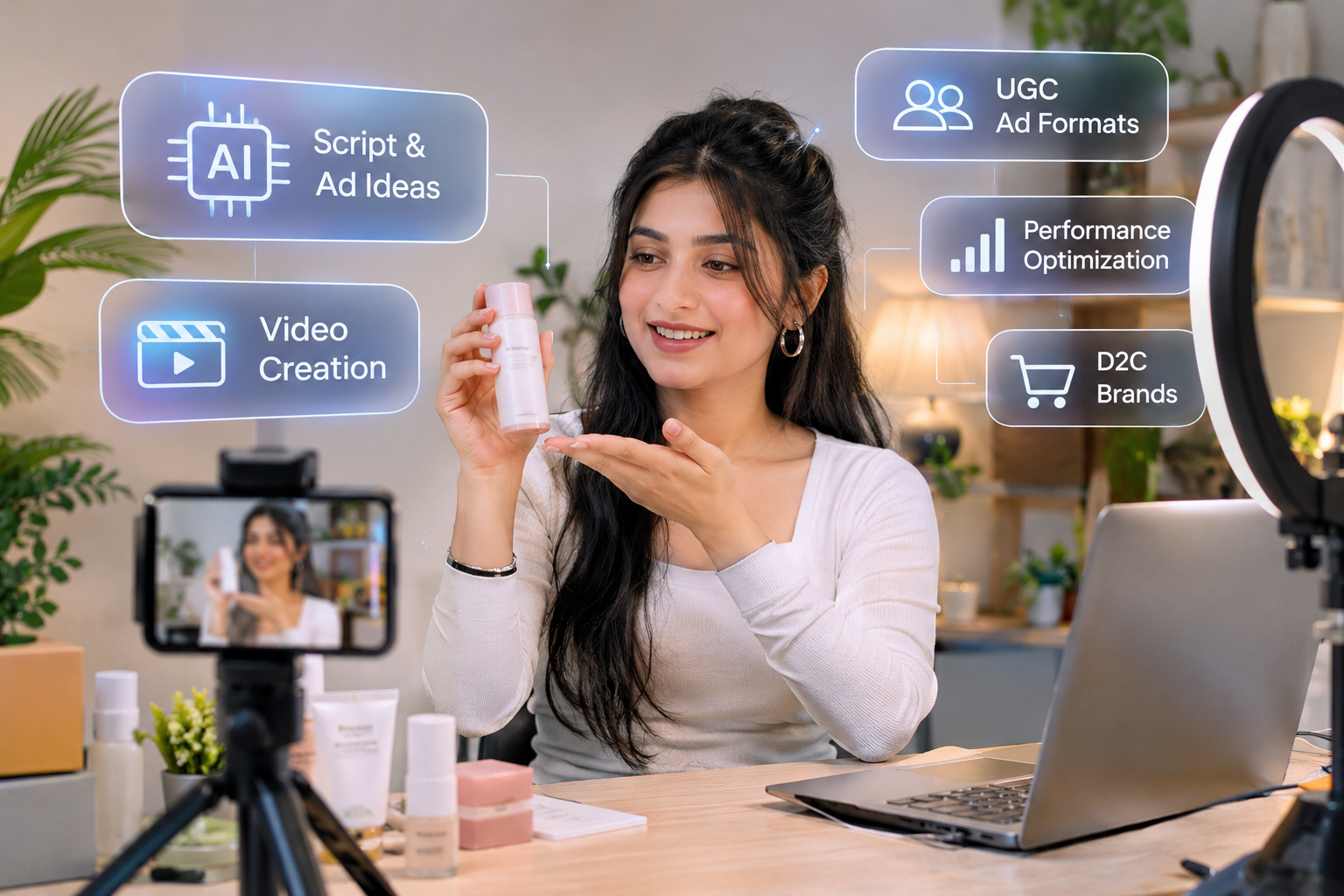
However, creating effective UGC ads consistently can be challenging. Brands need engaging ideas, compelling scripts, attractive visuals, product demonstrations, and strong calls to action.
Artificial Intelligence (AI) tools can simplify this process. They help marketers research audience preferences, generate video scripts, create advertising concepts, edit videos, improve product visuals, and develop multiple ad variations.
In this guide, you will learn how to create high-converting UGC ads for D2C brands using AI tools, from planning and scripting to video production and campaign optimisation.
1. What Are UGC Ads for D2C Brands?
UGC ads are advertisements created using content that looks and feels like genuine customer experiences. They typically feature product reviews, unboxing videos, tutorials, testimonials, product demonstrations, and personal recommendations.
For D2C brands, these advertisements help communicate product benefits in a relatable way.
For example, a skincare brand could create a short video showing how someone uses a product as part of their daily skincare routine. Instead of presenting a traditional promotional advertisement, the video focuses on the product experience.
Why Are UGC Ads Important for D2C Brands?
UGC advertising can help D2C businesses:
-
Build trust through relatable product experiences.
-
Demonstrate how products work in real-life situations.
-
Communicate product benefits clearly.
-
Create engaging social media advertisements.
-
Test different creative concepts and messaging.
-
Develop stronger connections with potential customers.
The objective is not simply to make an advertisement look like customer content. It is to communicate genuine product value through authentic and transparent storytelling.
2. How AI Tools Help Create UGC Ads
AI makes different stages of UGC ad creation easier and more organised. It can support content research, scripting, editing, visual production, and performance analysis.
2.1 Generate UGC Ad Ideas
The first step is identifying creative ideas that match your target audience.
AI can help generate concepts based on:
-
Customer problems and requirements.
-
Product features and benefits.
-
Frequently asked customer questions.
-
Common product objections.
-
Different customer use cases.
-
Seasonal marketing campaigns.
For example, a D2C fitness accessories brand could develop concepts such as a product demonstration, a beginner's experience, a problem-and-solution video, or a customer testimonial.
2.2 Create Engaging UGC Video Scripts
A good script gives the advertisement a clear direction. AI can help create scripts with attention-grabbing openings, relatable problems, product demonstrations, and calls to action.
A simple UGC ad script structure includes:
-
Hook: Capture attention in the first few seconds.
-
Problem: Introduce a relatable customer challenge.
-
Product introduction: Show how the product fits into the situation.
-
Demonstration: Explain or demonstrate relevant features.
-
Call to action: Encourage viewers to explore or purchase the product.
Example UGC script:
"Looking for an easier way to organise your everyday essentials? I recently started using this product, and it has made my daily routine much simpler. Here is how I use it. If you want to explore a practical solution, check it out today."
The script should be adapted to the actual product and real customer experience. Avoid fabricated testimonials or unsupported product claims.
2.3 Create AI-Assisted UGC Videos
AI-powered video production can help transform scripts, product footage, and approved creative assets into engaging advertisements.
Depending on the tool, marketers can use AI to:
-
Generate video scenes from text prompts.
-
Create subtitles and captions.
-
Remove unwanted background elements.
-
Improve video quality.
-
Generate voiceovers.
-
Resize videos for different platforms.
-
Produce multiple creative variations.
AI-generated presenters or synthetic customer-style videos should be clearly represented and must not be presented as genuine customer testimonials.
2.4 Improve Product Images and Visuals
Product visuals play an important role in UGC advertisements. AI-assisted editing can help improve lighting, backgrounds, framing, and product presentation.
For example, a D2C home decor brand can use AI-assisted visual editing to create different lifestyle settings while keeping the actual product's appearance accurate.
3. Step-by-Step Process to Create High-Converting UGC Ads Using AI
Step 1: Understand Your Target Audience
Before creating advertisements, identify who you want to reach.
Understand:
-
Age group and customer interests.
-
Buying behaviour.
-
Common product-related problems.
-
Reasons customers hesitate to purchase.
-
Product benefits customers value most.
Use customer feedback, reviews, support queries, and existing campaign insights to understand audience expectations.
AI can organise this information into audience segments and suggest relevant advertising angles.
Step 2: Select the Right UGC Ad Format
Different products require different advertising approaches.
Common UGC ad formats include:
Product Demonstration: Shows how a product works and explains its features.
Unboxing Video: Presents the packaging, product appearance, and first impressions.
Customer Testimonial: Shares an authentic customer's experience with appropriate permission.
Problem-and-Solution Video: Introduces a customer problem and demonstrates how the product addresses it.
Tutorial Video: Explains how to use the product through simple steps.
Choose a format that naturally communicates the product's value.
Step 3: Generate an Ad Script Using AI
Once you select the format, prepare a script that communicates one clear message.
For better results, provide AI with:
-
Product name and description.
-
Target audience.
-
Main product benefits.
-
Customer pain points.
-
Preferred video duration.
-
Desired tone and advertising objective.
Example AI prompt:
"Create a 30-second UGC advertisement script for a D2C skincare product. Target beginner skincare users. Start with an engaging hook, explain one common skincare concern, introduce the product naturally, demonstrate how it is used, and finish with a clear call to action. Keep the language conversational and avoid unsupported product claims."
Review and edit the generated script before production.
Step 4: Create the Video
Use authentic product footage, approved customer content, or clearly disclosed AI-generated creative assets.
Focus on:
-
Clear product visibility.
-
Natural presentation.
-
Good lighting and sound.
-
Simple backgrounds.
-
Readable subtitles.
-
A clear and consistent message.
Keep the video focused on one main product benefit instead of trying to communicate everything in a single advertisement.
Step 5: Add Captions, Voiceovers and Editing
AI-assisted editing can make video production more efficient.
Add subtitles so viewers can understand the advertisement without sound. Use voiceovers where appropriate, remove unnecessary pauses, and maintain a suitable pace.
Make sure the final video looks natural and accurately represents the product.
Step 6: Create Multiple Ad Variations
One creative concept may not work equally well for every audience.
Create different versions by changing:
-
Opening hooks.
-
Video introductions.
-
Product demonstrations.
-
Customer problems.
-
Calls to action.
-
Video formats and durations.
For example, the same product advertisement could have one version focused on convenience and another focused on ease of use.
Test the variations to identify which creative approach performs better.
4. How to Optimise UGC Ads for Better Conversions
Creating an advertisement is only the beginning. Regular optimisation helps D2C brands understand which creative elements contribute to campaign performance.
4.1 Improve the Opening Hook
The opening should quickly communicate why someone should continue watching.
Examples include:
-
"Struggling to find a simple solution for this problem?"
-
"Here is how I use this product in my daily routine."
-
"Before choosing your next product, consider this."
-
"Let me show you how this product works."
Use hooks that match the actual product and audience.
4.2 Focus on One Main Product Benefit
Avoid presenting too many features in a short advertisement. Select the most relevant benefit and demonstrate it clearly.
For example, a D2C kitchen products brand could focus on convenience, ease of use, or space-saving design.
4.3 Use Clear Calls to Action
Every advertisement should guide viewers towards the next step.
Examples include:
-
Explore the collection.
-
Discover the product.
-
Learn more about its features.
-
Shop the product today.
The CTA should match the campaign objective and landing page.
4.4 Analyse Advertising Performance
Monitor relevant performance indicators, including:
-
Click-through rate (CTR).
-
Conversion rate.
-
Cost per acquisition (CPA).
-
Return on ad spend (ROAS).
-
Video watch time.
-
Engagement rate.
Do not evaluate advertisements using a single metric. For example, high engagement does not necessarily mean high sales.
Use the results to identify which hooks, formats, and product messages deserve further testing.
5. Common Mistakes to Avoid When Creating AI-Powered UGC Ads
D2C brands should avoid the following mistakes:
Using Generic AI Scripts: Scripts that do not reflect the product or target audience can make advertisements less relatable.
Creating Fake Testimonials: Never present AI-generated statements or fictional customer experiences as genuine reviews.
Overusing AI Effects: Excessive editing and unrealistic visuals can reduce credibility.
Ignoring Product Accuracy: AI-generated images and videos must not misrepresent product features, packaging, or results.
Using Weak CTAs: A video without a clear next step may fail to guide interested viewers.
Not Testing Different Creatives: Depending on one advertisement limits the opportunity to learn what resonates with the audience.
Ignoring Customer Feedback: Real customer questions and experiences can provide valuable ideas for future UGC campaigns.
6. How D2C Marketers Can Develop AI and Digital Marketing Skills
Creating effective UGC advertisements requires a combination of creative thinking, audience research, video production, and digital marketing knowledge.
Learning these skills can help marketers develop more structured advertising campaigns.
At Upskill Now, learners can explore practical learning opportunities in artificial intelligence, digital marketing, and content creation. The AI Master Program covers areas such as Generative AI, prompt engineering, AI agents, and automation, which can support modern marketing workflows.
Learners interested in building broader marketing capabilities can also explore the Digital Marketing course and develop their understanding of content strategy, advertising, and digital campaign execution.
To understand the available learning opportunities, visit the Upskill Now homepage or explore the available courses.
Conclusion
Creating high-converting UGC ads for D2C brands using AI tools involves more than generating scripts or producing attractive videos. It requires understanding customer needs, choosing relevant advertising formats, communicating genuine product benefits, and continuously testing creative variations.
AI can make content planning, scriptwriting, video editing, and creative testing more efficient. However, authenticity, product accuracy, and customer trust should remain central to every advertisement.
D2C marketers who combine creative storytelling with AI and digital marketing skills can build more organised and effective advertising workflows.
If you want to develop these capabilities, explore the learning opportunities at Upskill Now and take the next step towards building practical AI and digital marketing skills.
Frequently Asked Questions (FAQs)
1. What are UGC ads for D2C brands?
UGC ads are advertisements that use customer-created content or customer-style storytelling to present products through reviews, demonstrations, tutorials, unboxing videos, and real experiences.
2. How can AI tools help create UGC ads?
AI tools can assist with generating advertising ideas, writing scripts, creating video concepts, editing footage, adding subtitles, generating voiceovers, and producing creative variations.
3. How do you create UGC video scripts using AI?
Provide AI with your product information, target audience, key benefits, customer problems, and advertising objective. Ask it to create a conversational script with a hook, product introduction, demonstration, and CTA. Review the script for accuracy before using it.
4. What types of UGC ads work for D2C brands?
Common formats include product demonstrations, unboxing videos, authentic customer testimonials, tutorials, and problem-and-solution advertisements. The right format depends on the product and target audience.
5. How can D2C brands improve conversions through AI-powered UGC ads?
Brands can test different hooks, improve product demonstrations, create relevant creative variations, use clear CTAs, and analyse metrics such as CTR, conversion rate, CPA, and ROAS. They should also maintain authentic and accurate product communication.
Contact Upskill Now
-
Address: A-3, Third Floor, Rajouri Garden, New Delhi – 110027, India
-
Contact Number: +91 99998 48160
-
Alternate Number: +91 97114 48765