Digital Marketing Skills for Beginners: SEO, Social Media, Google Ads & Content Marketing
Digital marketing has become a broad field with different skills, platforms, and career paths. For beginners, the challenge is often deciding what to learn first and understanding how different areas of digital marketing work together.
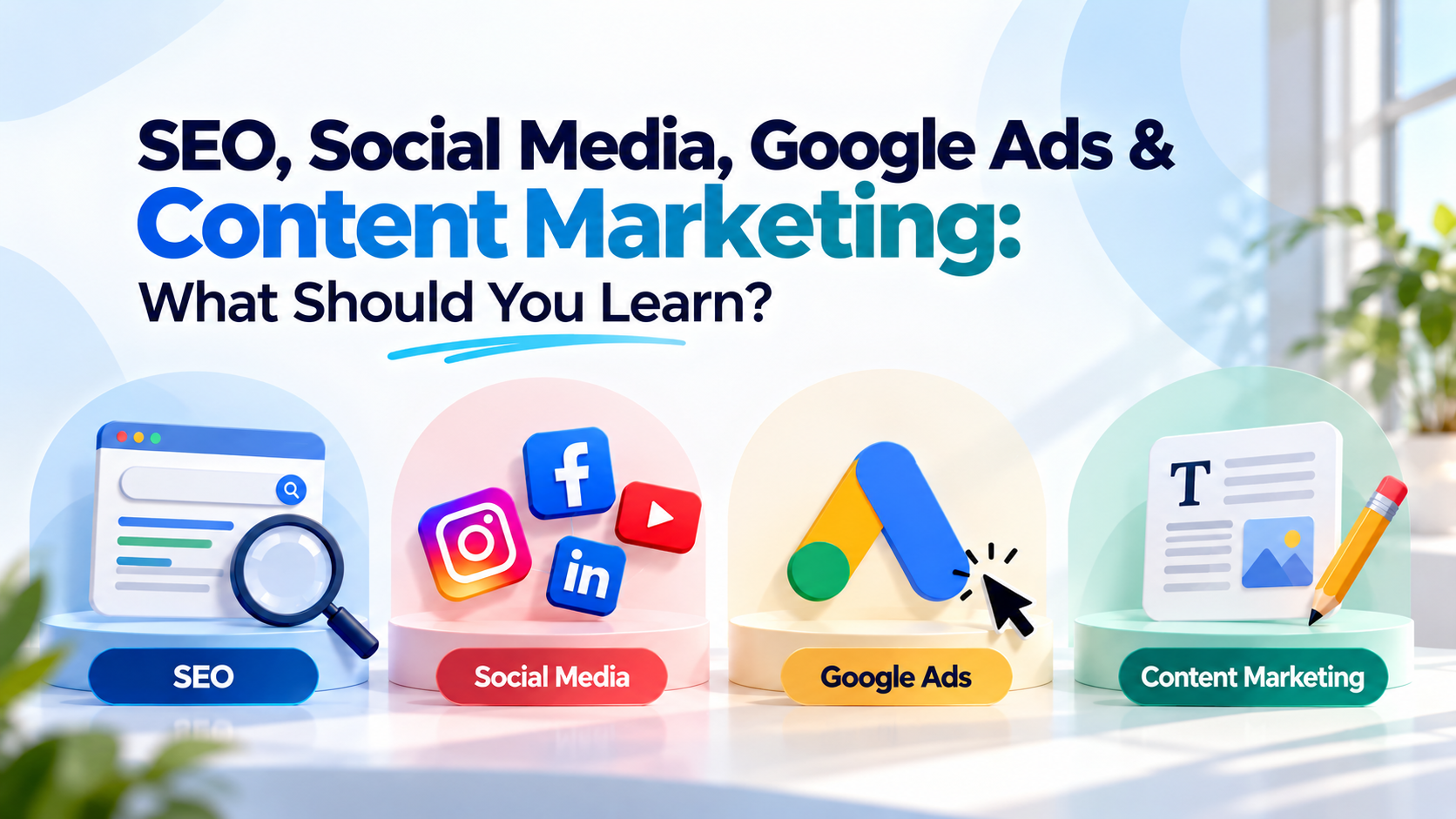
SEO, social media marketing, Google Ads, and content marketing are four important areas that can help build a strong digital marketing foundation. Each serves a different purpose, but they can also support the same marketing strategy.
This guide explains what beginners should learn in each area, how these skills work together, and how to develop practical experience through projects and portfolio work.
Digital Marketing Fundamentals Beginners Should Learn
Before specialising in SEO, social media, Google Ads, or content marketing, it is useful to understand the fundamentals of digital marketing.
These fundamentals include target audiences, customer journeys, marketing funnels, search intent, conversion rates, landing pages, online branding, and campaign measurement. Understanding these concepts makes it easier to see why businesses often use several marketing channels together.
For example, a company may use SEO to attract organic traffic, content marketing to educate visitors, social media to communicate with its audience, and Google Ads to reach people actively searching for a product or service.
SEO and Keyword Research
Search Engine Optimisation, commonly called SEO, involves improving websites and content so that they can become more visible in search engine results.
SEO is not simply about adding keywords to a webpage. It involves understanding what people search for, creating useful content, improving website structure, making pages easier to navigate, and helping search engines understand the website.
Important SEO Skills to Learn
- Keyword research
- Search intent analysis
- On-page SEO
- Technical SEO basics
- Internal linking
- Content optimisation
- Local SEO
- SEO performance analysis
Keyword research helps marketers identify the terms and topics their target audience searches for. Search intent then helps determine what type of information should be provided for those searches.
Beginners should also learn to evaluate a webpage from both the search engine and user perspective. A page should target relevant topics while clearly answering the user's question and providing a useful experience.
Social Media Marketing
Social media marketing focuses on using platforms such as Instagram, Facebook, LinkedIn, YouTube, and other social channels to communicate with audiences and build brand awareness.
Professional social media marketing involves more than creating posts. Marketers need to understand audience research, content planning, platform-specific strategies, community engagement, performance tracking, and campaign optimisation.
What Should You Learn in Social Media Marketing?
- Audience research
- Social media strategy
- Content calendars
- Caption writing
- Short-form video strategy
- Community management
- Social media analytics
- Paid social advertising basics
Different platforms can have different audience behaviour, so marketers need to understand how content and communication should be adapted to the platform being used.
Social media is particularly relevant for learners interested in communication, creativity, visual content, storytelling, and audience engagement.
Google Ads and Performance Marketing
Google Ads introduces beginners to paid search and performance marketing. Instead of waiting for organic search visibility, businesses can use paid campaigns to reach people searching for relevant products, services, or solutions.
Learning Google Ads requires more than knowing how to create an advertisement. Marketers should understand keywords, search intent, campaign structures, bidding, budgets, ad copy, landing pages, conversion tracking, and campaign performance.
Google Ads Skills Beginners Should Develop
- Keyword selection
- Search campaign structure
- Ad copywriting
- Audience and location targeting
- Budget management
- Conversion tracking
- Click-through rate analysis
- Cost-per-click analysis
- Campaign optimisation
Getting clicks is not the only objective of a paid campaign. Marketers also need to understand what happens after someone clicks an advertisement.
A well-planned campaign connects the advertisement, landing page, offer, audience, and conversion goal. This makes performance measurement an important part of learning Google Ads.
Content Marketing and Copywriting
Content marketing is the process of creating and distributing useful content to attract, educate, engage, and retain an audience. Content can include blogs, videos, social media posts, guides, newsletters, case studies, infographics, and other formats.
Good content marketing starts with understanding the audience. Before creating an article or social media post, marketers should know what problem they are trying to solve and what information the audience is looking for.
Content Marketing Skills to Learn
- Topic research
- Content planning
- Blog writing
- Copywriting
- Storytelling
- Content optimisation
- Visual content planning
- Content distribution
- Performance measurement
Copywriting focuses on communicating ideas clearly and encouraging the audience to take an intended action. Strong writing can help marketers create better headlines, advertisements, calls to action, emails, and website content.
Content marketing also connects with SEO and social media. A well-researched blog can attract search traffic, while parts of the same content can be adapted into social posts, videos, newsletters, or educational graphics.
How Digital Marketing Channels Work Together
SEO, social media, Google Ads, and content marketing should not always be treated as completely separate activities. A business can use several channels to support different stages of its marketing strategy.
For example, a company could create an informative blog about a service and optimise it for SEO. The same topic could then be converted into social media content. Google Ads could reach people actively searching for the service, while performance data could help the marketing team understand which activities are producing useful results.
This creates a connected marketing system rather than four independent activities.
Understanding these relationships can help beginners plan campaigns more effectively and understand how customers interact with a brand across different channels.
Which Digital Marketing Skill Should You Learn First?
There is no single starting point that works for everyone. The most suitable area can depend on your interests and the type of work you want to explore.
- SEO: suitable for learners interested in research, websites, keywords, and organic search.
- Social media: useful for learners interested in communication, creativity, visual content, and audience engagement.
- Google Ads: relevant for learners interested in data, testing, advertising, and measurable performance.
- Content marketing: useful for learners interested in writing, storytelling, research, and educational content.
Choosing one area initially does not mean ignoring the others. A broad understanding of digital marketing followed by deeper specialisation can provide a more complete skill set.
Practical Learning Path for Beginners
Trying to learn every digital marketing platform at the same time can become confusing. A structured learning path can make the process easier.
- Understand digital marketing fundamentals.
- Learn how websites, search engines, and audiences interact.
- Build basic SEO and keyword research knowledge.
- Learn content creation and copywriting.
- Understand social media marketing.
- Learn the fundamentals of Google Ads.
- Study analytics and campaign measurement.
- Practise through real or simulated projects.
- Create a portfolio showing your work.
- Gradually specialise in the area you want to explore further.
A structured digital marketing learning path can help beginners connect these areas instead of learning isolated tools without understanding how they fit into a campaign.
Practical Projects to Build Your Skills
Reading about digital marketing concepts is useful, but practical work helps you understand how those concepts operate in real situations.
For SEO, you could perform a basic website audit and create a keyword research document. For social media, you could develop a content calendar and analyse engagement. For Google Ads, you could create a sample campaign structure and calculate potential performance metrics.
For content marketing, you could write and optimise a complete blog article based on a specific audience and search intent.
These projects allow you to connect strategy with execution and identify areas where you need additional learning.
Hands-on work can also help you develop a practical digital marketing skill set instead of relying only on theoretical knowledge.
Tools Digital Marketers Should Know
Digital marketers work with many different tools, but beginners do not need to master every platform immediately.
For SEO, you can learn tools used for keyword research, website audits, search performance, and competitor research. For paid advertising, learn the Google Ads interface and understand campaign reporting.
For social media, explore tools for scheduling, analytics, content management, and campaign planning. Analytics tools are also important because marketing decisions should be based on measurable information rather than assumptions.
As you progress, you can explore AI tools, marketing automation, email marketing, conversion optimisation, and other specialised areas.
How to Build a Digital Marketing Portfolio
A portfolio can demonstrate your skills even when you do not have extensive professional experience.
You can create a portfolio around practical projects such as:
- An SEO audit of a sample website
- A keyword research project
- A complete blog content plan
- A social media content calendar
- A sample Google Ads campaign structure
- A landing page analysis
- A marketing performance report
- A complete digital marketing campaign plan
For every project, explain the objective, your approach, the tools you used, the work you completed, and what you learned. This makes your portfolio more useful than simply displaying screenshots.
Skills to Learn Next
Once you understand SEO, social media, Google Ads, and content marketing, you can gradually expand your skill set.
- Email marketing
- Marketing analytics
- Conversion rate optimisation
- Marketing automation
- AI-assisted marketing
- Influencer marketing
- Local SEO
- Performance marketing
- Lead generation
- Customer relationship management
These additional skills can help you understand the wider digital marketing ecosystem and work across different stages of a customer journey.
Build a Complete Digital Marketing Skill Set
Learning digital marketing is not about becoming an expert in every channel immediately. The goal is to understand how different marketing activities contribute to a common business objective.
Start with the fundamentals, develop working knowledge of SEO, social media, Google Ads, and content marketing, and then use practical projects to strengthen your skills.
If you are looking for structured learning, an AI digital marketing course can also help you understand how modern marketing workflows incorporate AI-assisted research, content creation, analytics, and automation.
Conclusion
SEO, social media, Google Ads, and content marketing each solve different marketing problems. SEO supports organic search visibility, social media helps businesses communicate with audiences, Google Ads supports paid acquisition, and content marketing provides useful information that can attract and educate potential customers.
For beginners, the most useful approach is to understand digital marketing as a complete discipline and then develop practical knowledge across these core areas. After building a broad foundation, you can specialise according to your interests and career goals.
The most important step is to practise. Create projects, analyse campaigns, experiment with content, study performance data, and build a portfolio that demonstrates your abilities. Digital marketing becomes easier to understand when you move from theory to practical execution.
Contact Details
A-3, Third Floor, Rajouri Garden, New Delhi – 110027
Phone: 9999848160 | 9711448765
Email: connect@upskillnow.in